Advertisements
Advertisements
प्रश्न
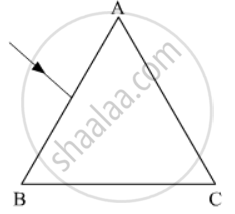
A ray of light incident at an angle of incidence ‘i’ passes through an equilateral glass prism such that the refracted ray inside the prism is parallel to its base and emerges from the prism at an angle of emergence ‘e’.
What can you say about the value of the angle of deviation in such a situation?
Advertisements
उत्तर
Angle of deviation becomes minimum in this situation.
संबंधित प्रश्न
Name the factors affecting the critical angle for the pair of media.
The figure shows a ray of light falling normally on the face AB of an equilateral glass prism having refractive index`3/2`, placed in water of refractive index `4/3`.Will this ray suffer total internal reflection on striking the face AC? Justify your answer.
State two conditions necessary for total internal reflection to occur.
The diagram shows a point source P inside a water container. Three rays A, B, and C starting from P are shown up to the water surface. Show in the diagram the path of these rays after striking the water surface. The critical angle for the water-air pair is 48°.

Solve Numerical example.
A monochromatic ray of light is incident at 37° on an equilateral prism of refractive index 3/2. Determine angle of emergence and angle of deviation. If angle of prism is adjustable, what should its value be for emergent rays to be just possible for the same angle of incidence?
Optical fibre communication uses the principle of ______.
The angle made by incident ray of light with normal of the reflecting surface is called ______.
- Assertion (A): Propagation of light through an optical fibre is due to total internal reflection taking place at the core-cladding interface.
- Reason (R): Refractive index of the material of the cladding of the optical fibre is greater than that of the core.
The critical angle for crown glass, which has a refractive index of 1.52, is:
The formation of a mirage is explained using:
