Advertisements
Advertisements
प्रश्न
Solve Numerical example.
A monochromatic ray of light is incident at 37° on an equilateral prism of refractive index 3/2. Determine angle of emergence and angle of deviation. If angle of prism is adjustable, what should its value be for emergent rays to be just possible for the same angle of incidence?
Advertisements
उत्तर
By Snell’s law, in case of prism,
n = `sin("i")/sin("r"_1)`
∴ `3/2=sin(37°)/sin("r"_1)`
∴ r1 = `sin^-1(0.6018/(3//2))`
= sin−1 (0.4012)
= 23°39’
For equilateral prism, A = 60°
Also, A= r1 + r2
∴ r2 = A − r1 = 60° – 23°39’ = 36°21’
Applying snell’s law on the second surface of prism,
`1/"n"=sin("r"_2)/sin("e")`
∴ `2/3=sin(36°21’)/sin("e")`
∴ e = `sin^-1((0.5927)/(2//3))`
= sin–1 (0.889)
= 62°44’
≈ 63
For any prism,
i + e = A + δ
∴ δ = (i + e) − A
= (37 + 63) − 60
= 40°
For an emergent ray to just emerge, the angle r2’ acts as a critical angle.
∴ r2’ = `sin^-1(1/"n")`
= `sin^-1(2/3)`
= 41’48°
As, A = r1 + r2 and i to be kept the same.
⇒ A’ = r1 + r2’ = 23°39’ + 41°48’
= 65°27’
- Angle of emergence and angle of deviation in first case are 63° and 40° respectively.
- For emergent ray to just emerge with same incident angle the angle of prism should have the value of 65°27’.
APPEARS IN
संबंधित प्रश्न
State the conditions required for total internal reflection of light to take place.
Name the factors affecting the critical angle for the pair of media.
Write the relation between the refractive index and critical angle for a given pair of optical media?
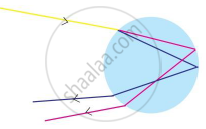
i) Observe the given figure and answer the following questions.
a) Identify and write the natural process shown in the figure.
b) List the phenomena which are observe in this process.
c) Redraw the diagram and show above phenomena in it.
Total internal reflection can take place only if ______.
Plot a graph between
Angle of incidence versus angle of refraction.
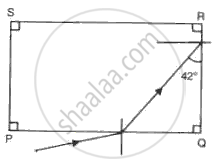
(a) A ray of monochromatic light enters glass PQRS as shown in the fig. Complete the path of ray till it emerges from the glass. (Critical angle of glass is 420).
(b) Draw diagram of a prism periscope.
(c) What are the advantages of total internal reflecting prism over plane mirror?
If a ray of light passes from medium I to medium II without any change of direction, what can be said about the refractive indices of these media (angle I is not 0)?
A ray of light incident at an angle of incidence ‘i’ passes through an equilateral glass prism such that the refracted ray inside the prism is parallel to its base and emerges from the prism at an angle of emergence ‘e’.
What can you say about the value of the angle of deviation in such a situation?
Draw a diagram, properly labelled, to illustrate the use of a total reflecting prism (a right-angled isosceles prism) to turn a ray of light through 180°. Name an instrument in which this device is used.
The diagram shows a point source P inside a water container. Three rays A, B, and C starting from P are shown up to the water surface. Show in the diagram the path of these rays after striking the water surface. The critical angle for the water-air pair is 48°.

A ray of light passes through a right-angled prism as shown in the figure. State the angles of incidence at the faces AC and BC.
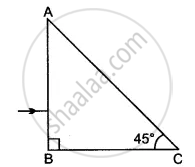
Complete the following diagram to show the path of the ray of a single colour in the diagram as if enters in and emerges out of the prism. Mark the angles wherever necessary. (Critical angle for glass = 42°).
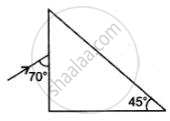
A ray of light is incident as a normal ray on the surface of separation of two different mediums. What is the value of the angle of incidence in this case?
Explain ‘mirage’ as an illustration of refraction.
Describe the construction and working of an optical fibre.
For a ray of light, the critical angle is minimum when it travels from ______.
The twinkling effect of star light is due to ______.
The outer concentric shell in optic fiber is called ______.
A bundle of glass threads, each of which is capable of transmitting messages using light waves is called ______.
What are the conditions to achieve total internal reflection?
What is the phenomenon used in optical fiber? Explain.
The phenomena involved in the reflection of radiowaves by ionosphere is similar to ______.
Find the value of θ in the given figure.
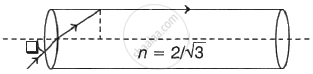
Small air bubbles rising up a fish tank appear silvery when viewed from some particular angle is due to the ______.
An endoscope uses optic fiber to transmit high resolution images of internal organs without loss of information. The principle of light that is used by the optic fiber is based on ______.
When a ray of light is refracted from one medium to another, then the wavelength changes from 6000 Å to 4000 Å. The critical angle for the interface will be ______.
