Advertisements
Advertisements
प्रश्न
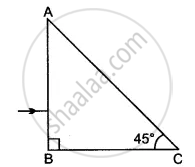
A ray of light passes through a right-angled prism as shown in the figure. State the angles of incidence at the faces AC and BC.
Advertisements
उत्तर
At AC – Angle is 45°
At BC – Angle is 0°
संबंधित प्रश्न
Which colour of light has a higher critical angle? Red light or green light.
In the given figure PQ and PR are the two light rays emerging from an object P. The ray PQ is refracted as QS.

- State the special name given to the angle of incidence ∠PQN of the ray PQ.
- What is the angle of refraction for the refracted ray QS?
- Name the phenomenon that occurs if the angle of incidence ∠PQN is increased.
- The ray PR suffers partial reflection and refraction on the water-air surface. Give reason.
- Draw in the diagram the refracted ray for the incident ray PR and hence show the position of image of the object P by the letter P’ when seen vertically from above.
One day Chetan’s mother developed a severe stomach ache all of a sudden. She was rushed to the doctor who suggested for an immediate endoscopy test and gave an estimate of expenditure for the same. Chetan immediately contacted his class teacher and shared the information with her. The class teacher arranged for the money and rushed to the hospital. On realizing that Chetan belonged to a below average income group family, even the doctor offered concession for the test fee. The test was conducted successfully.
Answer the following questions based on the above information:
(a) Which principle in optics is made use of in endoscopy?
(b) Briefly explain the values reflected in the action taken by the teacher.
(c) In what way do you appreciate the response of the doctor on the given situation?
Calculate the speed of light in a medium whose critical angle is 30° ?
Total internal reflection can take place only if ______.
What is meant by the term ‘critical angle’?
Solve Numerical example.
From the given data set, determine angular dispersion by the prism and dispersive power of its material for extreme colours. nR = 1.62 nV = 1.66, δR = 3.1°
For a ray of light, the critical angle is minimum when it travels from ______.
Optical fibre communication uses the principle of ______.
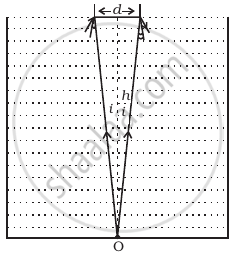
A jar of height h is filled with a transparent liquid of refractive index µ (Figure). At the centre of the jar on the bottom surface is a dot. Find the minimum diameter of a disc, such that when placed on the top surface symmetrically about the centre, the dot is invisible.