Advertisements
Advertisements
प्रश्न
Choose the correct option.
Angles of deviation for extreme colours are given for different prisms. Select the one having maximum dispersive power of its material.
पर्याय
7°, 10°
8°, 11°
12°, 16°
10°, 14°
Advertisements
उत्तर
7°, 10°
Explanation:
Dispersive power for thin prism is,
ω = `(δ_"V"-δ_"R")/(((δ_"V"+δ_"R")/2)`
∴ For values in option (A),
ω = `(10-7)/(((10+7)/2))=6/17` = 0.35
For values in option (B),
ω = `(11-8)/(((11+8)/2))=6/19` = 0.31
For values in option (C),
ω = `(16-12)/(((16+12)/2))=2/7` = 0.28
For values in option (D),
ω = `(14-10)/(((14+10)/2))=1/3` = 0.33
Thus, value of ω is maximum for prism with angles of deviations, 7°, 10°.
APPEARS IN
संबंधित प्रश्न
The figure shows a ray of light falling normally on the face AB of an equilateral glass prism having refractive index`3/2`, placed in water of refractive index `4/3`.Will this ray suffer total internal reflection on striking the face AC? Justify your answer.
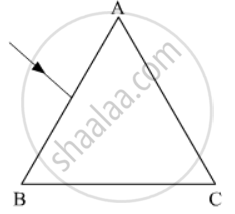
Draw the diagram of a right-angled isosceles prism which is used to make an invented image erect.
What do you understand by the deviation produced by a prism? Why is it caused?
Calculate the speed of light in a medium whose critical angle is 30° ?
Swarali has got the following observations while doing an experiment. Answer her questions with the help of observations.
Swarali observed that the light bent away from the normal, while travelling from dense medium to rarer medium. When Swarali increased the values of angle of incidence (i), the values of angle of refraction (r) went on increasing. But at a certain angle of incidence, the light rays returned into the dense medium.
So, Swarali has some questions. Answer them –
a) Name this certain value of ‘i ’. What is the value of ‘r’ at that time ?
b) Name this process of returning of light in dense medium. Explain the process.
Plot a graph between
Sine of angle of incidence versus sine of angle of refraction,
If a light ray does not undergo, refraction at the boundary between two media, the angle of incidence is:
Name the principle on the basis of which optical fibres work.
How are critical angles related to the refractive index of the medium?
Name the factors affecting the critical angle for the pair of media.
What is meant by the statement, ‘the critical angle for diamond is 24°’?
How is the critical angle of a material related to its refractive index?
Which of the following is not involved in formation of a rainbow?
Answer the following question.
Define the critical angle of incidence and obtain an expression for it.
Describe the construction and working of an optical fibre.
Critical angle of light passing from glass to air is maximum for ____________.
Optical fibre communication uses the principle of ______.
Which of the following statements about total internal reflection is true?
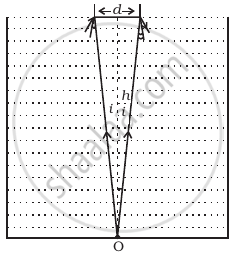
A jar of height h is filled with a transparent liquid of refractive index µ (Figure). At the centre of the jar on the bottom surface is a dot. Find the minimum diameter of a disc, such that when placed on the top surface symmetrically about the centre, the dot is invisible.
A light is entering from one medium refractive index `("RI" =5/3)` to another medium at an angle 30°. The angle of refraction for other medium is sin-1 `(5/6)`. then the increase in angle of incidence is ______ such that the ray of light reflected back into the same medium.
Which of the following is used in optical fibres?
The angle made by incident ray of light with normal of the reflecting surface is called ______.
Small air bubbles rising up a fish tank appear silvery when viewed from some particular angle is due to the ______.
Total internal reflection is defined as the complete reflection of light back into an optically denser medium when:
The critical angle is the angle of incidence in the denser medium for which the angle of refraction in the rarer medium is:
When the angle of incidence for light travelling from a denser medium to a rarer medium is greater than the critical angle, the result is:
The formation of a mirage is explained using:
