Advertisements
Advertisements
प्रश्न
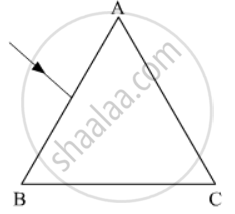
The figure shows a ray of light falling normally on the face AB of an equilateral glass prism having refractive index`3/2`, placed in water of refractive index `4/3`.Will this ray suffer total internal reflection on striking the face AC? Justify your answer.
Advertisements
उत्तर
For total internal reflection to happen at AC face, `sin theta >= mu_"water"/mu_"prism" = "4/3"/"3/2" = 8/9 = 0.89` where, θ is angle of incidence.
Now from the figure, we can see that angle of incidence will be 60 degrees.

So `sin 60 = sqrt3/2 = 0.866` which is less than 0.89
So total internal reflection will not take place at the face AC
APPEARS IN
संबंधित प्रश्न
State the relation between the critical angle and the absolute refractive index of a medium.
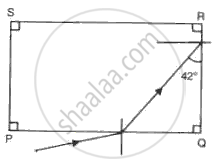
(a) A ray of monochromatic light enters glass PQRS as shown in the fig. Complete the path of ray till it emerges from the glass. (Critical angle of glass is 420).
(b) Draw diagram of a prism periscope.
(c) What are the advantages of total internal reflecting prism over plane mirror?
How does a ray of light bend when it travels from when it is normal to the interface of the two media.
Why do diamonds sparkle?
A ray of light incident at an angle of incidence ‘i’ passes through an equilateral glass prism such that the refracted ray inside the prism is parallel to its base and emerges from the prism at an angle of emergence ‘e’.
How is the angle of emergence ‘e’ related to the angle of incidence ‘i’?
Choose the correct option.
Select the WRONG statement.
For a ray of light, the critical angle is minimum when it travels from ______.
What is the phenomenon used in optical fiber? Explain.
Total internal reflection is defined as the complete reflection of light back into an optically denser medium when:
