Advertisements
Advertisements
प्रश्न
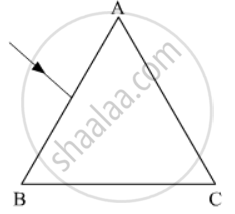
The figure shows a ray of light falling normally on the face AB of an equilateral glass prism having refractive index`3/2`, placed in water of refractive index `4/3`.Will this ray suffer total internal reflection on striking the face AC? Justify your answer.
Advertisements
उत्तर
For total internal reflection to happen at AC face, `sin theta >= mu_"water"/mu_"prism" = "4/3"/"3/2" = 8/9 = 0.89` where, θ is angle of incidence.
Now from the figure, we can see that angle of incidence will be 60 degrees.

So `sin 60 = sqrt3/2 = 0.866` which is less than 0.89
So total internal reflection will not take place at the face AC
APPEARS IN
संबंधित प्रश्न
Plot a graph between
Sine of angle of incidence versus sine of angle of refraction,
Plot a graph between
Angle of incidence versus angle of refraction.
Why do diamonds sparkle?
If a ray of light passes from medium I to medium II without any change of direction, what can be said about the refractive indices of these media (angle I is not 0)?
A ray of light incident at an angle of incidence ‘i’ passes through an equilateral glass prism such that the refracted ray inside the prism is parallel to its base and emerges from the prism at an angle of emergence ‘e’.
What can you say about the value of the angle of deviation in such a situation?
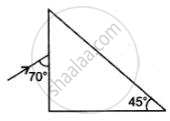
Complete the following diagram to show the path of the ray of a single colour in the diagram as if enters in and emerges out of the prism. Mark the angles wherever necessary. (Critical angle for glass = 42°).
The angle of minimum deviation produced by a thin glass prism in air is 'δ'. If that prism is immersed in water, the angle of minimum deviation will be ______.
( aμg = refractive index of glass w.r.t, air aμw = refractive index of water w.r.t. air)
The twinkling effect of star light is due to ______.
What is the phenomenon used in optical fiber? Explain.
When the angle of incidence for light travelling from a denser medium to a rarer medium is greater than the critical angle, the result is:
