Advertisements
Advertisements
प्रश्न
How does a ray of light bend when it travels from rarer to denser medium
Advertisements
उत्तर
When a ray of light travels from rarer to the denser medium it bends towards the normal.
संबंधित प्रश्न
Plot a graph between
Angle of incidence versus angle of refraction.
If a light ray does not undergo, refraction at the boundary between two media, the angle of incidence is:
Name the principle on the basis of which optical fibres work.
A ray of light incident at an angle of incidence ‘i’ passes through an equilateral glass prism such that the refracted ray inside the prism is parallel to its base and emerges from the prism at an angle of emergence ‘e’.
How is the angle of emergence ‘e’ related to the angle of incidence ‘i’?
A ray of light incident at an angle of incidence ‘i’ passes through an equilateral glass prism such that the refracted ray inside the prism is parallel to its base and emerges from the prism at an angle of emergence ‘e’.
What can you say about the value of the angle of deviation in such a situation?
What is meant by the term ‘critical angle’?
Choose the correct option.
Angles of deviation for extreme colours are given for different prisms. Select the one having maximum dispersive power of its material.
Answer the following question.
Under what conditions are total internal reflection possible? Explain it with a suitable example.
Describe the construction and working of an optical fibre.
The diagram below shows a fish in the tank and its image seen on the surface of the water.
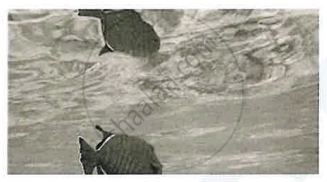
Name the phenomenon responsible for the formation of this image.
