Advertisements
Advertisements
प्रश्न
Answer the following question.
Under what conditions are total internal reflection possible? Explain it with a suitable example.
Advertisements
उत्तर
Conditions for total internal reflection:
- The light ray must travel from denser medium to rarer medium.
- The angle of incidence in the denser medium must be greater than critical angle for the given pair of media.
Total internal reflection in optical fibre:
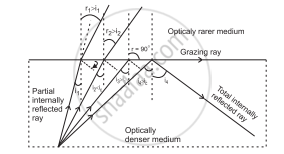
- Consider an optical fibre made up of the core of refractive index n1 and cladding of refractive index n2 such that, n1 > n2.
- When a ray of light is incident from a core (denser medium), the refracted ray is bent away from the normal.
- At a particular angle of incidence ic in the denser medium, the corresponding angle of refraction in the rarer medium is 90°.
- For angles of incidence greater than ic, the angle of refraction becomes larger than 90° and the ray does not enter into the rarer medium at all but is reflected totally into the denser medium as shown in the figure.
APPEARS IN
संबंधित प्रश्न
State the relation between the critical angle and the absolute refractive index of a medium.
Which colour of light has a higher critical angle? Red light or green light.
Angle of deviation is the angle which the ______ ray makes with the direction of ______ray.
What do you understand by the deviation produced by a prism? Why is it caused?
What is total internal reflection?
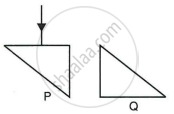
Two isosceles right-angle glass prisms P and Q are placed near each other as shown in Fig. Complete the path of the light ray entering the prism P till it emerges out of the prism Q.
Write the relation between the refractive index and critical angle for a given pair of optical media?
One day Chetan’s mother developed a severe stomach ache all of a sudden. She was rushed to the doctor who suggested for an immediate endoscopy test and gave an estimate of expenditure for the same. Chetan immediately contacted his class teacher and shared the information with her. The class teacher arranged for the money and rushed to the hospital. On realizing that Chetan belonged to a below average income group family, even the doctor offered concession for the test fee. The test was conducted successfully.
Answer the following questions based on the above information:
(a) Which principle in optics is made use of in endoscopy?
(b) Briefly explain the values reflected in the action taken by the teacher.
(c) In what way do you appreciate the response of the doctor on the given situation?
The diagram below shows a light source P embedded in a rectangular glass block ABCD of critical angle 42°. Complete the path of the ray PQ till it emerges out of the block. [Write necessary angles].

Define critical angle for a given medium.
Plot a graph between
Angle of incidence versus angle of reflection,
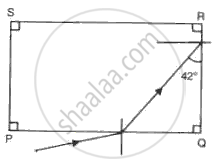
(a) A ray of monochromatic light enters glass PQRS as shown in the fig. Complete the path of ray till it emerges from the glass. (Critical angle of glass is 420).
(b) Draw diagram of a prism periscope.
(c) What are the advantages of total internal reflecting prism over plane mirror?
How does a ray of light bend when it travels from when it is normal to the interface of the two media.
Images formed by totally reflecting prisms are brighter than the image formed by ordinary reflected light, why?
A ray of light incident at an angle of incidence ‘i’ passes through an equilateral glass prism such that the refracted ray inside the prism is parallel to its base and emerges from the prism at an angle of emergence ‘e’.
What can you say about the value of the angle of deviation in such a situation?
What is meant by the statement, ‘the critical angle for diamond is 24°’?
How is the critical angle of a material related to its refractive index?
The adjacent diagram shows two right-angled isosceles prisms A and B. Complete the diagram to show the path of rays P and Q emerging out of the prism B. What principles have you used to complete the diagram?

Complete the following diagram to show the path of the ray of a single colour in the diagram as if enters in and emerges out of the prism. Mark the angles wherever necessary. (Critical angle for glass = 42°).

A ray of light is incident on a glass surface at an angle of 50° with the corresponding angle of refraction 30°. Find the value of the R.I. of glass.
Which of the following is not involved in formation of a rainbow?
Solve Numerical example.
From the given data set, determine angular dispersion by the prism and dispersive power of its material for extreme colours. nR = 1.62 nV = 1.66, δR = 3.1°
The angle of minimum deviation produced by a thin glass prism in air is 'δ'. If that prism is immersed in water, the angle of minimum deviation will be ______.
( aμg = refractive index of glass w.r.t, air aμw = refractive index of water w.r.t. air)
Optical fibre communication uses the principle of ______.
The entire light is reflected back into the denser medium is called ______.
The outer concentric shell in optic fiber is called ______.
Which of the following statements about total internal reflection is true?
What is a mirage? How does it occur?
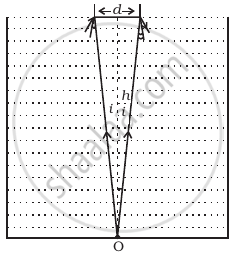
A jar of height h is filled with a transparent liquid of refractive index µ (Figure). At the centre of the jar on the bottom surface is a dot. Find the minimum diameter of a disc, such that when placed on the top surface symmetrically about the centre, the dot is invisible.
A ray of light passes through a prism of refractive index `sqrt2` as shown in the figure. Find:
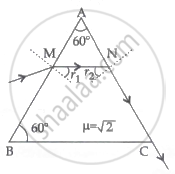
- The angle of incidence (∠r2) at face AC.
- The angle of minimum deviation for this prism.
Small air bubbles rising up a fish tank appear silvery when viewed from some particular angle is due to the ______.
The critical angle is the angle of incidence in the denser medium for which the angle of refraction in the rarer medium is:
When the angle of incidence for light travelling from a denser medium to a rarer medium is greater than the critical angle, the result is:
The formation of a mirage is explained using:
