Advertisements
Advertisements
प्रश्न
Answer the following question.
Under what conditions are total internal reflection possible? Explain it with a suitable example.
Advertisements
उत्तर
Conditions for total internal reflection:
- The light ray must travel from denser medium to rarer medium.
- The angle of incidence in the denser medium must be greater than critical angle for the given pair of media.
Total internal reflection in optical fibre:
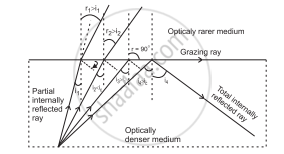
- Consider an optical fibre made up of the core of refractive index n1 and cladding of refractive index n2 such that, n1 > n2.
- When a ray of light is incident from a core (denser medium), the refracted ray is bent away from the normal.
- At a particular angle of incidence ic in the denser medium, the corresponding angle of refraction in the rarer medium is 90°.
- For angles of incidence greater than ic, the angle of refraction becomes larger than 90° and the ray does not enter into the rarer medium at all but is reflected totally into the denser medium as shown in the figure.
APPEARS IN
संबंधित प्रश्न
The diagram below shows a point source P inside a water container. Four rays A, B, C, D starting from the source P, are shown up to the water surface.
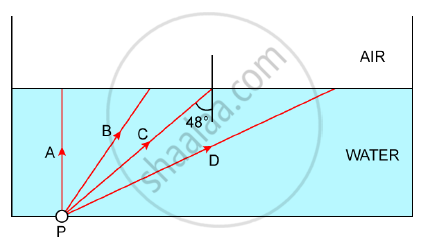
- Show in the diagram the path of these rays after striking the water surface. The Critical Angle for the water-air surface is 48°.
- Name the phenomenon which the rays B and D exhibit.
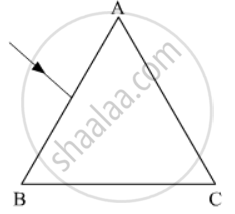
The figure shows a ray of light falling normally on the face AB of an equilateral glass prism having refractive index`3/2`, placed in water of refractive index `4/3`.Will this ray suffer total internal reflection on striking the face AC? Justify your answer.
Which colour of light has a higher critical angle? Red light or green light.
A light ray does not bend at the boundary in passing from one medium to the other medium if the angle of incident is ______.
What is total internal reflection?
State two conditions necessary for total internal reflection to occur.
In the given figure PQ and PR are the two light rays emerging from an object P. The ray PQ is refracted as QS.

- State the special name given to the angle of incidence ∠PQN of the ray PQ.
- What is the angle of refraction for the refracted ray QS?
- Name the phenomenon that occurs if the angle of incidence ∠PQN is increased.
- The ray PR suffers partial reflection and refraction on the water-air surface. Give reason.
- Draw in the diagram the refracted ray for the incident ray PR and hence show the position of image of the object P by the letter P’ when seen vertically from above.
Write the relation between the refractive index and critical angle for a given pair of optical media?
Define critical angle for a given medium.
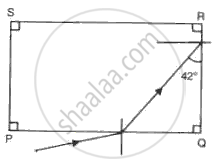
(a) A ray of monochromatic light enters glass PQRS as shown in the fig. Complete the path of ray till it emerges from the glass. (Critical angle of glass is 420).
(b) Draw diagram of a prism periscope.
(c) What are the advantages of total internal reflecting prism over plane mirror?
Why do diamonds sparkle?
Can light be ‘piped’ like sound in a doctor’s stethoscope?
If a ray of light passes from medium I to medium II without any change of direction, what can be said about the refractive indices of these media (angle I is not 0)?
How is the critical angle of a material related to its refractive index?
Draw a diagram, properly labelled, to illustrate the use of a total reflecting prism (a right-angled isosceles prism) to turn a ray of light through 180°. Name an instrument in which this device is used.
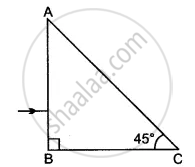
A ray of light passes through a right-angled prism as shown in the figure. State the angles of incidence at the faces AC and BC.
The adjacent diagram shows two right-angled isosceles prisms A and B. Complete the diagram to show the path of rays P and Q emerging out of the prism B. What principles have you used to complete the diagram?

Complete the following diagram to show the path of the ray of a single colour in the diagram as if enters in and emerges out of the prism. Mark the angles wherever necessary. (Critical angle for glass = 42°).

A ray of light is incident on a glass surface at an angle of 50° with the corresponding angle of refraction 30°. Find the value of the R.I. of glass.
Choose the correct option.
Select the WRONG statement.
Choose the correct option.
Angles of deviation for extreme colours are given for different prisms. Select the one having maximum dispersive power of its material.
Explain ‘mirage’ as an illustration of refraction.
Answer the following question.
Define the critical angle of incidence and obtain an expression for it.
For a ray of light, the critical angle is minimum when it travels from ______.
Optical fibre communication uses the principle of ______.
The twinkling effect of star light is due to ______.
A bundle of glass threads, each of which is capable of transmitting messages using light waves is called ______.
Optical Fibres are based on the phenomenon of dispersion.
The angle of incidence at which the angle of refraction is Q£ is called the critical angle.
What are the conditions to achieve total internal reflection?
What is a mirage? How does it occur?
What is the phenomenon used in optical fiber? Explain.
What are the examples of total internal reflection in nature?
The phenomena involved in the reflection of radiowaves by ionosphere is similar to ______.
A Rainbow is a beautiful natural phenomenon formed because of the following:
A ray of light passes from vacuum into a medium of refractive index µ, the angle of incidence is found to be twice the angle of refraction. Then the angle of incidence is ______.
Name any two phenomena which take place in the formation of a rainbow.
