Advertisements
Advertisements
प्रश्न
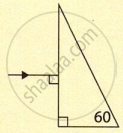
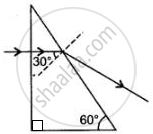
Complete the following diagram to show the path of the ray of a single colour in the diagram as if enters in and emerges out of the prism. Mark the angles wherever necessary. (Critical angle for glass = 42°).

Copy and complete the following diagram to show the path of the ray of monochromatic light as it enters and emerges from the prism. Mark the angle wherever necessary (critical angle is 42°).
Advertisements
उत्तर
APPEARS IN
संबंधित प्रश्न
What is total internal reflection?
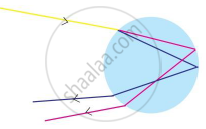
i) Observe the given figure and answer the following questions.
a) Identify and write the natural process shown in the figure.
b) List the phenomena which are observe in this process.
c) Redraw the diagram and show above phenomena in it.
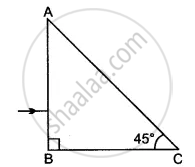
A ray of light passes through a right-angled prism as shown in the figure. State the angles of incidence at the faces AC and BC.
Choose the correct option.
Select the WRONG statement.
Which of the following is not involved in formation of a rainbow?
A ray of light incident at an angle θ on a refracting face of a prism emerges from the other face normally. If the angle of the prism is 5° and the prism is made of a material of refractive index 1.5, the angle of incidence is ______.
State the condition under which total internal reflection occurs. Give the mathematical expression for total internal reflection.
Observe the given figure of the raindrop and answer the following questions:
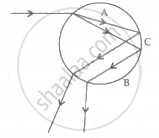
- Label A and B of the given diagram. Why colour will deviate most.
- Name the phenomenon shown in label C.
The angle made by incident ray of light with normal of the reflecting surface is called ______.
- Assertion (A): Propagation of light through an optical fibre is due to total internal reflection taking place at the core-cladding interface.
- Reason (R): Refractive index of the material of the cladding of the optical fibre is greater than that of the core.
