Advertisements
Advertisements
Questions
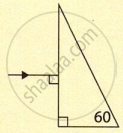
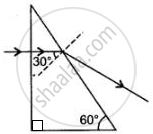
Complete the following diagram to show the path of the ray of a single colour in the diagram as if enters in and emerges out of the prism. Mark the angles wherever necessary. (Critical angle for glass = 42°).

Copy and complete the following diagram to show the path of the ray of monochromatic light as it enters and emerges from the prism. Mark the angle wherever necessary (critical angle is 42°).
Advertisements
Solution
APPEARS IN
RELATED QUESTIONS
You are given prisms made of crown glass and flint glass with a wide variety of angles. Suggest a combination of prisms which will
(a) deviate a pencil of white light without much dispersion,
(b) disperse (and displace) a pencil of white light without much deviation.
State the conditions required for total internal reflection of light to take place.
Total internal reflection can take place only if ______.
The diagram below shows a light source P embedded in a rectangular glass block ABCD of critical angle 42°. Complete the path of the ray PQ till it emerges out of the block. [Write necessary angles].

The diagram shows a point source P inside a water container. Three rays A, B, and C starting from P are shown up to the water surface. Show in the diagram the path of these rays after striking the water surface. The critical angle for the water-air pair is 48°.

A ray of light is incident as a normal ray on the surface of separation of two different mediums. What is the value of the angle of incidence in this case?
Choose the correct option.
Select the WRONG statement.
Answer the following question.
Define the critical angle of incidence and obtain an expression for it.
A Rainbow is a beautiful natural phenomenon formed because of the following:
