Advertisements
Advertisements
Question
Total internal reflection can take place only if ______.
Options
light goes from an optically rarer medium (smaller refractive index) to optically denser medium
light goes from optically denser medium to rarer
mediumthe refractive indices of the two media are close to each other
the refractive indices of the two media are widely different.
Advertisements
Solution
Total internal reflection can take place only if the light goes from an optically denser medium to a rarer medium.
Explanation:
The angle of incidence is greater than the critical angle.
APPEARS IN
RELATED QUESTIONS
The diagram below shows a point source P inside a water container. Four rays A, B, C, D starting from the source P, are shown up to the water surface.
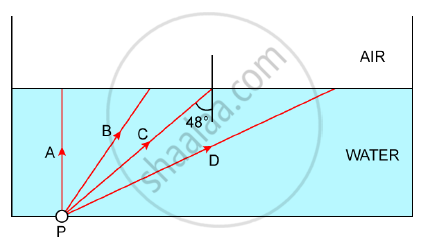
- Show in the diagram the path of these rays after striking the water surface. The Critical Angle for the water-air surface is 48°.
- Name the phenomenon which the rays B and D exhibit.
Draw the diagram of a right-angled isosceles prism which is used to make an invented image erect.
Name two factors which affect the critical angle for a given pair of media. State how do the factors affect it.
Express the refractive index μ of a medium in terms of the angle of incidence i in air and the angle of refraction r in a denser medium.
State two advantages of using a right-angle prism as a reflector, rather than a plane mirror.
A ray of light incident at an angle of incidence ‘i’ passes through an equilateral glass prism such that the refracted ray inside the prism is parallel to its base and emerges from the prism at an angle of emergence ‘e’.
How is the angle of emergence ‘e’ related to the angle of incidence ‘i’?
A ray of light incident at an angle of incidence ‘i’ passes through an equilateral glass prism such that the refracted ray inside the prism is parallel to its base and emerges from the prism at an angle of emergence ‘e’.
What can you say about the value of the angle of deviation in such a situation?
Choose the correct option.
Select the WRONG statement.
Describe the construction and working of an optical fibre.
Solve Numerical example.
From the given data set, determine angular dispersion by the prism and dispersive power of its material for extreme colours. nR = 1.62 nV = 1.66, δR = 3.1°
A green light is incident from the water to the air-water interface at the critical angle (C). Select the correct statement.
The critical angle is defined as the angle of incidence at which the total internal reflection starts to occur.
The angle of incidence at which the angle of refraction is Q£ is called the critical angle.
Write any two uses of total internal reflection.
A ray of light passes from vacuum into a medium of refractive index µ, the angle of incidence is found to be twice the angle of refraction. Then the angle of incidence is ______.
The angle made by incident ray of light with normal of the reflecting surface is called ______.
- Assertion (A): Propagation of light through an optical fibre is due to total internal reflection taking place at the core-cladding interface.
- Reason (R): Refractive index of the material of the cladding of the optical fibre is greater than that of the core.
When the angle of incidence for light going from a denser medium to a rarer medium is exactly equal to the critical angle, the result is:
As the angle of incidence increases for light going from a denser medium to a rarer medium, the angle of refraction:
The critical angle for crown glass, which has a refractive index of 1.52, is:
