Advertisements
Advertisements
Question
Solve Numerical example.
From the given data set, determine angular dispersion by the prism and dispersive power of its material for extreme colours. nR = 1.62 nV = 1.66, δR = 3.1°
Advertisements
Solution
Given: nR = 1.62, nV = 1.66, δR = 3.1°
To find: i. Angular dispersion (δVR)
ii. Dispersive power (ωVR)
Formula: i. δ = A (n − 1)
ii. δVR = δV − δR
iii. ω = `(δ_"V"-δ_"R")/(((δ_"V"+δ_"R")/2))`
Calculation: From formula (i),
δR = A(nR − 1)
∴ A = `δ_"R"/(("n"_"R"-1))=3.1/((1.62-1))=3.1/0.62`
∴ δV = A(nV − 1) = 5 × (1.66 − 1) = 3.3°
From formula (ii),
δVR = 3.3 − 3.1 = 0.2°
From formula (iii),
ωVR = `(3.3-3.1)/(((3.3+3.1)/2))=0.2/6.4xx2=0.2/3.2=1/16`
= 0.0625
- Angular dispersion by prism is 0.2°
- Dispersive power of material of prism is 0.0625.
APPEARS IN
RELATED QUESTIONS
A ray of light travels from water to air as shown in the diagram given below :
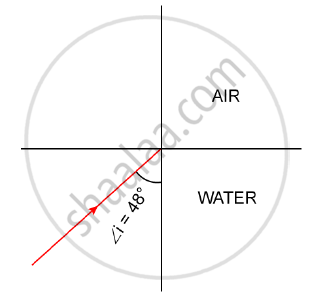
1) Copy the diagram and complete the path of the way. Given the critical angle for water is 48°.
2) State the condition so that internal reflection occurs in the above diagram.
Name the factors affecting the critical angle for the pair of media.
What is total internal reflection?
Calculate the speed of light in a medium whose critical angle is 30° ?
Solve the previous problem if the paperweight is inverted at its place so that the spherical surface touches the paper.
Plot a graph between
Angle of incidence versus angle of refraction.
Why do diamonds sparkle?
State one factor on which a critical angle for a given pair of media depends. The critical angle for the glass-air interface is 45° for the yellow light. Will it be equal to, less than or greater than 45° for (i) red light, (ii) blue light?
The diagram shows a point source P inside a water container. Three rays A, B, and C starting from P are shown up to the water surface. Show in the diagram the path of these rays after striking the water surface. The critical angle for the water-air pair is 48°.

Complete the following diagram to show the path of the ray of a single colour in the diagram as if enters in and emerges out of the prism. Mark the angles wherever necessary. (Critical angle for glass = 42°).

A ray of light is incident as a normal ray on the surface of separation of two different mediums. What is the value of the angle of incidence in this case?
A spherical marble, of refractive index 1.5 and curvature 1.5 cm, contains a tiny air bubble at its centre. Where will it appear when seen from outside?
Answer the following question.
Define the critical angle of incidence and obtain an expression for it.
Describe the construction and working of an optical fibre.
Solve Numerical example.
A monochromatic ray of light is incident at 37° on an equilateral prism of refractive index 3/2. Determine angle of emergence and angle of deviation. If angle of prism is adjustable, what should its value be for emergent rays to be just possible for the same angle of incidence?
For a ray of light, the critical angle is minimum when it travels from ______.
The entire light is reflected back into the denser medium is called ______.
A bundle of glass threads, each of which is capable of transmitting messages using light waves is called ______.
The angle of incidence at which the angle of refraction is Q£ is called the critical angle.
The phenomena involved in the reflection of radiowaves by ionosphere is similar to ______.
Which of the following is used in optical fibres?
A ray of light passes from vacuum into a medium of refractive index µ, the angle of incidence is found to be twice the angle of refraction. Then the angle of incidence is ______.
Find the value of θ in the given figure.
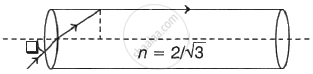
If even one of the two required conditions for total internal reflection is missing, then:
The critical angle for crown glass, which has a refractive index of 1.52, is:
The formation of a mirage is explained using:
