Advertisements
Advertisements
Question
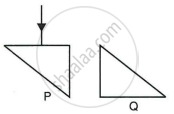
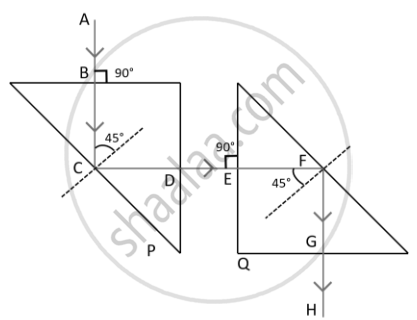
Two isosceles right-angle glass prisms P and Q are placed near each other as shown in Fig. Complete the path of the light ray entering the prism P till it emerges out of the prism Q.
Advertisements
Solution
RELATED QUESTIONS
Draw the diagram of a right-angled isosceles prism which is used to make an invented image erect.
A light ray does not bend at the boundary in passing from one medium to the other medium if the angle of incident is ______.
How does a ray of light bend when it travels from when it is normal to the interface of the two media.
If a ray of light passes from medium I to medium II without any change of direction, what can be said about the refractive indices of these media (angle I is not 0)?
Name the factors affecting the critical angle for the pair of media.
Which of the following is not involved in formation of a rainbow?
Explain ‘mirage’ as an illustration of refraction.
The resultant `vec"R"` of `vec"P"` and `vec"Q"` is perpendicular to `vec"P"`. Also `|vec"P"|=|vec"R"|`. The angle between `vec"P"` and `vec"Q"` is ______.
[tan 45° = 1]
A green light is incident from the water to the air-water interface at the critical angle (C). Select the correct statement.
When the angle of incidence for light travelling from a denser medium to a rarer medium is greater than the critical angle, the result is:
