Advertisements
Advertisements
Question
Which of the following is not involved in formation of a rainbow?
Options
refraction
angular dispersion
angular deviation
total internal reflection
Advertisements
Solution
Angular deviation
Explanation:
A rainbow is created when raindrops that are suspended in the air scatter sunlight. We perceive a rainbow because of the way light refracts when it enters a raindrop, total internal reflection from the rear of the droplet surface, and further refracted out in the atmosphere. So all the given processes, i.e., total internal reflection, refraction, and dispersion, take place in the rainbow formation. Angular deviation of light doesn't occur in the formation of a rainbow.
APPEARS IN
RELATED QUESTIONS
State the conditions required for total internal reflection of light to take place.
A ray of light travels from water to air as shown in the diagram given below :
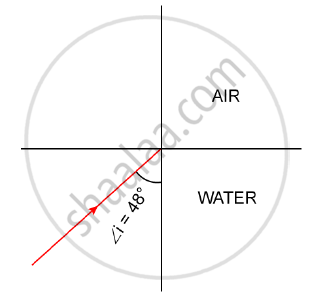
1) Copy the diagram and complete the path of the way. Given the critical angle for water is 48°.
2) State the condition so that internal reflection occurs in the above diagram.
Which colour of light has a higher critical angle? Red light or green light.
A light ray does not bend at the boundary in passing from one medium to the other medium if the angle of incident is ______.
What is total internal reflection?
Draw diagram to illustrate the total internal reflection.
Total internal reflection can take place only if ______.
Define critical angle for a given medium.
In the following figure, show two rays A and B travelling from water to air. If the critical angle for water- air surface is 48°, complete the ray diagram showing the refracted rays for each. State conditions when the ray will suffer total internal reflection.
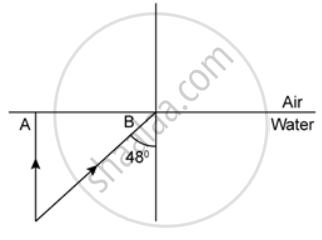
How does a ray of light bend when it travels from rarer to denser medium
How are critical angles related to the refractive index of the medium?
What is meant by the statement, ‘the critical angle for diamond is 24°’?
What is meant by the term ‘critical angle’?
A ray of light passes through a right-angled prism as shown in the figure. State the angles of incidence at the faces AC and BC.
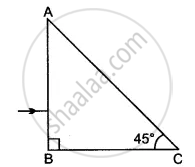
Complete the following diagram to show the path of the ray of a single colour in the diagram as if enters in and emerges out of the prism. Mark the angles wherever necessary. (Critical angle for glass = 42°).
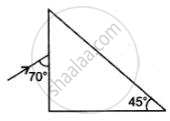
Choose the correct option.
Consider the following phenomena/ applications: P) Mirage, Q) rainbow, R) Optical fibre and S) glittering of a diamond. Total internal reflection is involved in
Explain ‘mirage’ as an illustration of refraction.
Answer the following question.
Under what conditions are total internal reflection possible? Explain it with a suitable example.
The resultant `vec"R"` of `vec"P"` and `vec"Q"` is perpendicular to `vec"P"`. Also `|vec"P"|=|vec"R"|`. The angle between `vec"P"` and `vec"Q"` is ______.
[tan 45° = 1]
Which one of the following is NOT the correct formula for refractive index of glass w.r.t. air (aμg) (i = angle of incidence, r = angle of refraction)
A particle is projected such that the horizontal range and vertical height are equal. Then the angle of projection is :
The critical angle is defined as the angle of incidence at which the total internal reflection starts to occur.
Write any two uses of total internal reflection.
Total internal reflection is defined as the complete reflection of light back into an optically denser medium when:
The critical angle is the angle of incidence in the denser medium for which the angle of refraction in the rarer medium is:
