Advertisements
Advertisements
Questions
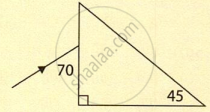
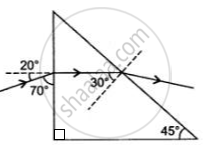
Complete the following diagram to show the path of the ray of a single colour in the diagram as if enters in and emerges out of the prism. Mark the angles wherever necessary. (Critical angle for glass = 42°).
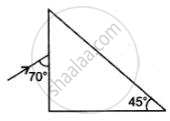
Copy and complete the following diagram to show the path of the ray of monochromatic light as it enters and emerges from the prism. Mark the angle wherever necessary (critical angle is 42°).
Advertisements
Solution
APPEARS IN
RELATED QUESTIONS
Angle of deviation is the angle which the ______ ray makes with the direction of ______ray.
A ray of light is incident as a normal ray on the surface of separation of two different mediums. What is the value of the angle of incidence in this case?
Describe the construction and working of an optical fibre.
Which of the following statements about total internal reflection is true?
Optical Fibres are based on the phenomenon of dispersion.
A green light is incident from the water to the air-water interface at the critical angle (θ). Select the correct statement.
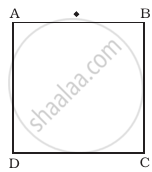
A rectangular block of glass ABCD has a refractive index 1.6. A pin is placed midway on the face AB (Figure). When observed from the face AD, the pin shall ______.
- appear to be near A.
- appear to be near D.
- appear to be at the centre of AD.
- not be seen at all.
Small air bubbles rising up a fish tank appear silvery when viewed from some particular angle is due to the ______.
When the angle of incidence for light travelling from a denser medium to a rarer medium is greater than the critical angle, the result is:
The critical angle for water, which has a refractive index of 1.33, is:
