Advertisements
Advertisements
Question
A ray of light incident at an angle θ on a refracting face of a prism emerges from the other face normally. If the angle of the prism is 5° and the prism is made of a material of refractive index 1.5, the angle of incidence is ______.
Options
7.5°
5°
15°
2.5°
Advertisements
Solution
A ray of light incident at an angle θ on a refracting face of a prism emerges from the other face normally. If the angle of the prism is 5° and the prism is made of a material of refractive index 1.5, the angle of incidence is 7.5°.
Explanation:
In thin prisms, the distance between the refracting surfaces is ineligible and the angle of prism (A) is very small. Since A = r1 + r2, therefore if A is small then both r1 and r2 are also small, and the same is true for i1 and i2.

A = 5°
μ = 1.5
i2 = 0°
r2 = 0°
r1 + r2 = A
r1 = A - r2 = 5 – 0 = 5°
μ = `(sini1)/(sinrlμ) = (sinil)/(sinrl)`
⇒ `sini1 = μsinr1`
= `1.5 xx sin 5°`
= 1.5 xx 0.087`
= 0.1305
= 7.5°
APPEARS IN
RELATED QUESTIONS
What is total internal reflection?
Define critical angle for a given medium.
Plot a graph between
Angle of incidence versus angle of reflection,
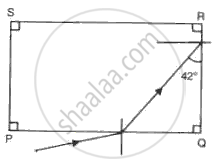
(a) A ray of monochromatic light enters glass PQRS as shown in the fig. Complete the path of ray till it emerges from the glass. (Critical angle of glass is 420).
(b) Draw diagram of a prism periscope.
(c) What are the advantages of total internal reflecting prism over plane mirror?
How does a ray of light bend when it travels from rarer to denser medium
If a ray of light passes from medium I to medium II without any change of direction, what can be said about the refractive indices of these media (angle I is not 0)?
Draw a diagram, properly labelled, to illustrate the use of a total reflecting prism (a right-angled isosceles prism) to turn a ray of light through 180°. Name an instrument in which this device is used.
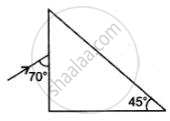
Complete the following diagram to show the path of the ray of a single colour in the diagram as if enters in and emerges out of the prism. Mark the angles wherever necessary. (Critical angle for glass = 42°).
PQ and PR are two light rays emerging from the object as shown in the figure below:

(i) What is the special name given to the angle of incidence (∠PQN) of ray PQ?
(ii) Copy the ray diagram and complete it to show the position of the image of the object P when seen obliquely from above.
(iii) Name the phenomenon that occurs if the angle of incidence ∠PQN is increased still further.
Choose the correct option.
Consider the following phenomena/ applications: P) Mirage, Q) rainbow, R) Optical fibre and S) glittering of a diamond. Total internal reflection is involved in
Choose the correct option.
Angles of deviation for extreme colours are given for different prisms. Select the one having maximum dispersive power of its material.
Solve Numerical example.
From the given data set, determine angular dispersion by the prism and dispersive power of its material for extreme colours. nR = 1.62 nV = 1.66, δR = 3.1°
A green light is incident from the water to the air-water interface at the critical angle (C). Select the correct statement.
For the same angle of incidence, the angle of refraction in four media A, B, C and D are 25°, 30°, 35° and 40° respectively. The speed of light is least in medium ______.
The outer concentric shell in optic fiber is called ______.
A bundle of glass threads, each of which is capable of transmitting messages using light waves is called ______.
What are the examples of total internal reflection in nature?
Small air bubbles rising up a fish tank appear silvery when viewed from some particular angle is due to the ______.
The critical angle is the angle of incidence in the denser medium for which the angle of refraction in the rarer medium is:
