Advertisements
Advertisements
प्रश्न
A ray of light incident at an angle θ on a refracting face of a prism emerges from the other face normally. If the angle of the prism is 5° and the prism is made of a material of refractive index 1.5, the angle of incidence is ______.
विकल्प
7.5°
5°
15°
2.5°
Advertisements
उत्तर
A ray of light incident at an angle θ on a refracting face of a prism emerges from the other face normally. If the angle of the prism is 5° and the prism is made of a material of refractive index 1.5, the angle of incidence is 7.5°.
Explanation:
In thin prisms, the distance between the refracting surfaces is ineligible and the angle of prism (A) is very small. Since A = r1 + r2, therefore if A is small then both r1 and r2 are also small, and the same is true for i1 and i2.

A = 5°
μ = 1.5
i2 = 0°
r2 = 0°
r1 + r2 = A
r1 = A - r2 = 5 – 0 = 5°
μ = `(sini1)/(sinrlμ) = (sinil)/(sinrl)`
⇒ `sini1 = μsinr1`
= `1.5 xx sin 5°`
= 1.5 xx 0.087`
= 0.1305
= 7.5°
APPEARS IN
संबंधित प्रश्न
Angle of deviation is the angle which the ______ ray makes with the direction of ______ray.
A light ray does not bend at the boundary in passing from one medium to the other medium if the angle of incident is ______.
Write the necessary conditions for the phenomenon of total internal reflection to
occur ?
Calculate the speed of light in a medium whose critical angle is 30° ?
Make the correct choices for each of the following :
Total Internal reflection takes place when
(where ∠i = angle of incidence, ∠r = angle of refraction, ∠C = critical angle)
In the following figure, show two rays A and B travelling from water to air. If the critical angle for water- air surface is 48°, complete the ray diagram showing the refracted rays for each. State conditions when the ray will suffer total internal reflection.
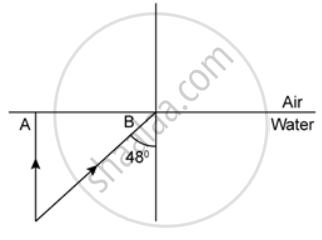
How does a ray of light bend when it travels from when it is normal to the interface of the two media.
Can light be ‘piped’ like sound in a doctor’s stethoscope?
Choose the correct option.
Consider the following phenomena/ applications: P) Mirage, Q) rainbow, R) Optical fibre and S) glittering of a diamond. Total internal reflection is involved in
A spherical marble, of refractive index 1.5 and curvature 1.5 cm, contains a tiny air bubble at its centre. Where will it appear when seen from outside?
Answer the following question.
Under what conditions are total internal reflection possible? Explain it with a suitable example.
Answer the following question.
Why is prism binoculars preferred over traditional binoculars? Describe its working in brief.
Observe the given figure and write appropriate phenomenon of light in the box.
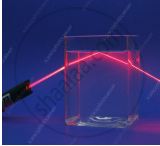
A green light is incident from the water to the air-water interface at the critical angle (C). Select the correct statement.
The twinkling effect of star light is due to ______.
The entire light is reflected back into the denser medium is called ______.
A light is entering from one medium refractive index `("RI" =5/3)` to another medium at an angle 30°. The angle of refraction for other medium is sin-1 `(5/6)`. then the increase in angle of incidence is ______ such that the ray of light reflected back into the same medium.
