Advertisements
Advertisements
प्रश्न
Total internal reflection can take place only if ______.
विकल्प
light goes from an optically rarer medium (smaller refractive index) to optically denser medium
light goes from optically denser medium to rarer
mediumthe refractive indices of the two media are close to each other
the refractive indices of the two media are widely different.
Advertisements
उत्तर
Total internal reflection can take place only if the light goes from an optically denser medium to a rarer medium.
Explanation:
The angle of incidence is greater than the critical angle.
APPEARS IN
संबंधित प्रश्न
You are given prisms made of crown glass and flint glass with a wide variety of angles. Suggest a combination of prisms which will
(a) deviate a pencil of white light without much dispersion,
(b) disperse (and displace) a pencil of white light without much deviation.
i) Observe the given figure and answer the following questions.
a) Identify and write the natural process shown in the figure.
b) List the phenomena which are observe in this process.
c) Redraw the diagram and show above phenomena in it.
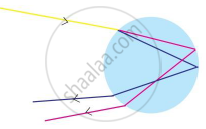
If a light ray does not undergo, refraction at the boundary between two media, the angle of incidence is:
How does a ray of light bend when it travels from rarer to denser medium
Express the refractive index μ of a medium in terms of the angle of incidence i in air and the angle of refraction r in a denser medium.
A ray of light incident at an angle of incidence ‘i’ passes through an equilateral glass prism such that the refracted ray inside the prism is parallel to its base and emerges from the prism at an angle of emergence ‘e’.
What can you say about the value of the angle of deviation in such a situation?
State one factor on which a critical angle for a given pair of media depends. The critical angle for the glass-air interface is 45° for the yellow light. Will it be equal to, less than or greater than 45° for (i) red light, (ii) blue light?
What is meant by the statement, ‘the critical angle for diamond is 24°’?
Which of the following is not involved in formation of a rainbow?
Describe the construction and working of an optical fibre.
Answer the following question.
Why is prism binoculars preferred over traditional binoculars? Describe its working in brief.
Solve Numerical example.
From the given data set, determine angular dispersion by the prism and dispersive power of its material for extreme colours. nR = 1.62 nV = 1.66, δR = 3.1°
The twinkling effect of star light is due to ______.
Which of the following statements about total internal reflection is true?
The angle of incidence at which the angle of refraction is Q£ is called the critical angle.
A light is entering from one medium refractive index `("RI" =5/3)` to another medium at an angle 30°. The angle of refraction for other medium is sin-1 `(5/6)`. then the increase in angle of incidence is ______ such that the ray of light reflected back into the same medium.
State two differences between normal reflection and total internal reflection.
The critical angle is the angle of incidence in the denser medium for which the angle of refraction in the rarer medium is:
The critical angle for water, which has a refractive index of 1.33, is:
