Advertisements
Advertisements
प्रश्न
If a light ray does not undergo, refraction at the boundary between two media, the angle of incidence is:
विकल्प
0°
45°
60°
90°
Advertisements
उत्तर
0°
APPEARS IN
संबंधित प्रश्न
A ray of light travels from water to air as shown in the diagram given below :
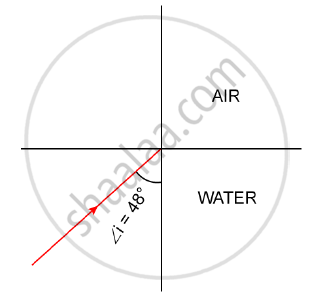
1) Copy the diagram and complete the path of the way. Given the critical angle for water is 48°.
2) State the condition so that internal reflection occurs in the above diagram.
The figure shows a ray of light falling normally on the face AB of an equilateral glass prism having refractive index`3/2`, placed in water of refractive index `4/3`.Will this ray suffer total internal reflection on striking the face AC? Justify your answer.
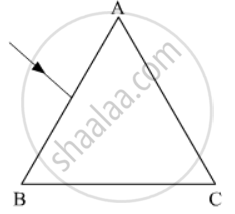
Total internal reflection occurs only when a ray of light passes from a ______ medium to a ______ medium.
Plot a graph between
Angle of incidence versus angle of reflection,
State two advantages of using a right-angle prism as a reflector, rather than a plane mirror.
Images formed by totally reflecting prisms are brighter than the image formed by ordinary reflected light, why?
For a ray of light, the critical angle is minimum when it travels from ______.
Observe the given figure of the raindrop and answer the following questions:
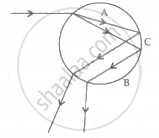
- Label A and B of the given diagram. Why colour will deviate most.
- Name the phenomenon shown in label C.
The diagram below shows a fish in the tank and its image seen on the surface of the water.
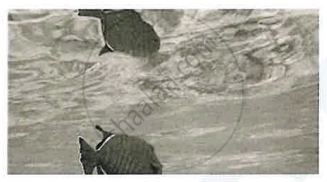
Name the phenomenon responsible for the formation of this image.
