Advertisements
Advertisements
प्रश्न
Answer the following question.
Why is prism binoculars preferred over traditional binoculars? Describe its working in brief.
Advertisements
उत्तर
- Traditional binoculars use only two cylinders. Distance between the two cylinders can’t be greater than that between the two eyes. This creates a limitation of the field of view.
- A prism binocular has two right-angled glass prisms that apply the principle of total internal reflection.
- The incident light rays are reflected internally twice giving the viewer a wider field of view. For this reason, prism binoculars are preferred over traditional binoculars.
Working:

Prism binoculars
- The prism binoculars consist of 4 isosceles, right-angled prisms of a material having a critical angle less than 45°.
- The prism binoculars have a wider input range compared to traditional binoculars.
- The light rays incident on the prism binoculars, first get total internally reflected by the isosceles, right-angled prisms 1 and 4.
- These reflected rays undergo another total internal reflection by prisms 2 and 3 to form the final image.
APPEARS IN
संबंधित प्रश्न
Name the factors affecting the critical angle for the pair of media.
Angle of deviation is the angle which the ______ ray makes with the direction of ______ray.
Calculate the speed of light in a medium whose critical angle is 30° ?
Total internal reflection can take place only if ______.
How does a ray of light bend when it travels from rarer to denser medium
Why do diamonds sparkle?
Write down the relationship between the critical angle and the refractive index of the medium.
Express the refractive index μ of a medium in terms of the angle of incidence i in air and the angle of refraction r in a denser medium.
Images formed by totally reflecting prisms are brighter than the image formed by ordinary reflected light, why?
A ray of light incident at an angle of incidence ‘i’ passes through an equilateral glass prism such that the refracted ray inside the prism is parallel to its base and emerges from the prism at an angle of emergence ‘e’.
What can you say about the value of the angle of deviation in such a situation?
Name the factors affecting the critical angle for the pair of media.
How is the critical angle of a material related to its refractive index?
Draw a diagram, properly labelled, to illustrate the use of a total reflecting prism (a right-angled isosceles prism) to turn a ray of light through 180°. Name an instrument in which this device is used.
The adjacent diagram shows two right-angled isosceles prisms A and B. Complete the diagram to show the path of rays P and Q emerging out of the prism B. What principles have you used to complete the diagram?

PQ and PR are two light rays emerging from the object as shown in the figure below:

(i) What is the special name given to the angle of incidence (∠PQN) of ray PQ?
(ii) Copy the ray diagram and complete it to show the position of the image of the object P when seen obliquely from above.
(iii) Name the phenomenon that occurs if the angle of incidence ∠PQN is increased still further.
Answer the following question.
Under what conditions are total internal reflection possible? Explain it with a suitable example.
Answer the following question.
What are the advantages of optical fibre communication over electronic communication?
Solve Numerical example.
A monochromatic ray of light is incident at 37° on an equilateral prism of refractive index 3/2. Determine angle of emergence and angle of deviation. If angle of prism is adjustable, what should its value be for emergent rays to be just possible for the same angle of incidence?
Solve Numerical example.
From the given data set, determine angular dispersion by the prism and dispersive power of its material for extreme colours. nR = 1.62 nV = 1.66, δR = 3.1°
The outer concentric shell in optic fiber is called ______.
A bundle of glass threads, each of which is capable of transmitting messages using light waves is called ______.
State the condition under which total internal reflection occurs. Give the mathematical expression for total internal reflection.
Observe the given figure of the raindrop and answer the following questions:
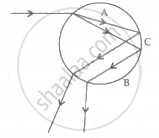
- Label A and B of the given diagram. Why colour will deviate most.
- Name the phenomenon shown in label C.
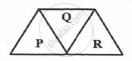
A given ray of light suffers minimum deviation in an equilateral prism P. Additional prism Q and R of identical shape and of the same material as P are now added as shown in the figure. The ray will now suffer ______.
State two differences between normal reflection and total internal reflection.
When the angle of incidence for light travelling from a denser medium to a rarer medium is greater than the critical angle, the result is:
