Advertisements
Advertisements
प्रश्न
Advertisements
उत्तर
Critical angle is the angle of incidence in the denser medium for which the angle of refraction in the rarer medium is 90o.
Total internal reflection: When a ray of light travelling from an optically denser medium to an optically rare medium is incident at an angle greater than the critical angle for the pair of media in contact, the ray is totally reflected back into the denser medium. This phenomenon is referred as total internal reflection.
The two necessary conditions for total internal reflection to take place are:
1. The light ray must proceed from denser to rarer medium.
2. Angle of incidence in denser medium should be greater than the critical angle for the pair of media in contact.
Relation between critical angle and r.i.: The critical angle can thus be calculated by taking the inverse-sine ratio of speed of light in denser medium and the speed of light in rarer.
ic = sin -1 `(("n"gamma)/("n"_i))`
APPEARS IN
संबंधित प्रश्न
A light ray does not bend at the boundary in passing from one medium to the other medium if the angle of incident is ______.
State two conditions necessary for total internal reflection to occur.
Prove the statement.
A rainbow is the combined effect of the refraction, dispersion, and total internal reflection of light.
Make the correct choices for each of the following :
Total Internal reflection takes place when
(where ∠i = angle of incidence, ∠r = angle of refraction, ∠C = critical angle)
Can light be ‘piped’ like sound in a doctor’s stethoscope?
How is the critical angle of a material related to its refractive index?
Answer the following question.
Why is prism binoculars preferred over traditional binoculars? Describe its working in brief.
Which of the following statements about total internal reflection is true?
What is a mirage? How does it occur?
A rectangular block of glass ABCD has a refractive index 1.6. A pin is placed midway on the face AB (Figure). When observed from the face AD, the pin shall ______.
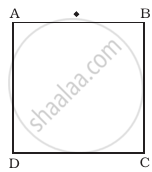
- appear to be near A.
- appear to be near D.
- appear to be at the centre of AD.
- not be seen at all.
