Advertisements
Advertisements
प्रश्न
A green light is incident from the water to the air-water interface at the critical angle (C). Select the correct statement.
विकल्प
The entire spectrum of visible light will come out of the water at an angle of 90° to the normal.
The spectrum of visible light whose frequency is less than that of green light will come out to the air medium.
The spectrum of visible light whose frequency is more than that of green light will come out to the air medium.
The entire spectrum of visible light will come out of the water at various angles to the normal.
Advertisements
उत्तर
The spectrum of visible light whose frequency is less than that of green light will come out to the air medium.
Explanation:
`sin i_C = 1/n` and `n prop 1/lambda`
For greater wavelength (i.e., lesser frequency) n is less. Hence, iC would be more. Thus, these wavelengths will not suffer internal reflection and come out at angles less than 90°.
संबंधित प्रश्न
Calculate the speed of light in a medium whose critical angle is 30° ?
Prove the statement.
A rainbow is the combined effect of the refraction, dispersion, and total internal reflection of light.
The observation made by Swarali while doing the experiment is given below. Based on these write answers to the questions:
Swarali found that the light ray travelling from the denser medium to rarer medium goes away from the normal. If the angle of incidence (i) is raised by Swarali, the angle of refraction (r) went on increasing. However, after certain value of the angle of incidence the light ray is seen to return back into the denser medium.
Questions:
- What is the specific value of∠i called?
- What is the process of reflection of incident rays into denser medium called?
- Draw the diagrams of three observations made by Swarali.
Name the principle on the basis of which optical fibres work.
A ray of light incident at an angle of incidence ‘i’ passes through an equilateral glass prism such that the refracted ray inside the prism is parallel to its base and emerges from the prism at an angle of emergence ‘e’.
What can you say about the value of the angle of deviation in such a situation?
What are the conditions to achieve total internal reflection?
What are the examples of total internal reflection in nature?
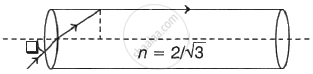
A ray of light incident at an angle θ on a refracting face of a prism emerges from the other face normally. If the angle of the prism is 5° and the prism is made of a material of refractive index 1.5, the angle of incidence is ______.
Find the value of θ in the given figure.
When a ray of light is refracted from one medium to another, then the wavelength changes from 6000 Å to 4000 Å. The critical angle for the interface will be ______.
