Advertisements
Advertisements
Question
Advertisements
Solution
Critical angle is the angle of incidence in the denser medium for which the angle of refraction in the rarer medium is 90o.
Total internal reflection: When a ray of light travelling from an optically denser medium to an optically rare medium is incident at an angle greater than the critical angle for the pair of media in contact, the ray is totally reflected back into the denser medium. This phenomenon is referred as total internal reflection.
The two necessary conditions for total internal reflection to take place are:
1. The light ray must proceed from denser to rarer medium.
2. Angle of incidence in denser medium should be greater than the critical angle for the pair of media in contact.
Relation between critical angle and r.i.: The critical angle can thus be calculated by taking the inverse-sine ratio of speed of light in denser medium and the speed of light in rarer.
ic = sin -1 `(("n"gamma)/("n"_i))`
APPEARS IN
RELATED QUESTIONS
Draw the diagram of a right-angled isosceles prism which is used to make an invented image erect.
Plot a graph between
Angle of incidence versus angle of refraction.
Why do diamonds sparkle?
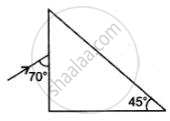
Complete the following diagram to show the path of the ray of a single colour in the diagram as if enters in and emerges out of the prism. Mark the angles wherever necessary. (Critical angle for glass = 42°).

Complete the following diagram to show the path of the ray of a single colour in the diagram as if enters in and emerges out of the prism. Mark the angles wherever necessary. (Critical angle for glass = 42°).
Which one of the following is NOT the correct formula for refractive index of glass w.r.t. air (aμg) (i = angle of incidence, r = angle of refraction)
The critical angle is defined as the angle of incidence at which the total internal reflection starts to occur.
A rectangular block of glass ABCD has a refractive index 1.6. A pin is placed midway on the face AB (Figure). When observed from the face AD, the pin shall ______.
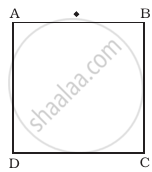
- appear to be near A.
- appear to be near D.
- appear to be at the centre of AD.
- not be seen at all.
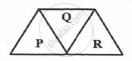
A given ray of light suffers minimum deviation in an equilateral prism P. Additional prism Q and R of identical shape and of the same material as P are now added as shown in the figure. The ray will now suffer ______.
Small air bubbles rising up a fish tank appear silvery when viewed from some particular angle is due to the ______.
