Advertisements
Advertisements
Question
Advertisements
Solution
APPEARS IN
RELATED QUESTIONS
Make the correct choices for each of the following :
Total Internal reflection takes place when
(where ∠i = angle of incidence, ∠r = angle of refraction, ∠C = critical angle)
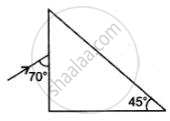
Complete the following diagram to show the path of the ray of a single colour in the diagram as if enters in and emerges out of the prism. Mark the angles wherever necessary. (Critical angle for glass = 42°).
Explain ‘mirage’ as an illustration of refraction.
What are the conditions to achieve total internal reflection?
Write any two uses of total internal reflection.
A light is entering from one medium refractive index `("RI" =5/3)` to another medium at an angle 30°. The angle of refraction for other medium is sin-1 `(5/6)`. then the increase in angle of incidence is ______ such that the ray of light reflected back into the same medium.
Small air bubbles rising up a fish tank appear silvery when viewed from some particular angle is due to the ______.
State two differences between normal reflection and total internal reflection.
When the angle of incidence for light travelling from a denser medium to a rarer medium is greater than the critical angle, the result is:
As the angle of incidence increases for light going from a denser medium to a rarer medium, the angle of refraction:
