Advertisements
Advertisements
Question
State two differences between normal reflection and total internal reflection.
Advertisements
Solution
| Reflection | Total Internal Reflection |
| Takes place in any medium, denser or rarer. | Takes place only in a denser medium. |
| Takes place for any angle of incidence. | Takes place only when the angle of incidence is greater than critical angle. |
APPEARS IN
RELATED QUESTIONS
Name the factors affecting the critical angle for the pair of media.
(i) Define critical angle.
(ii) State one important factor which affects the critical angle of a given medium.
A ray of light passes through a right-angled prism as shown in the figure. State the angles of incidence at the faces AC and BC.
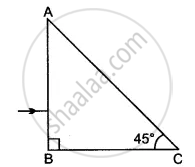
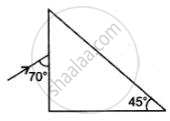
Complete the following diagram to show the path of the ray of a single colour in the diagram as if enters in and emerges out of the prism. Mark the angles wherever necessary. (Critical angle for glass = 42°).
Answer the following question.
Under what conditions are total internal reflection possible? Explain it with a suitable example.
Solve Numerical example.
From the given data set, determine angular dispersion by the prism and dispersive power of its material for extreme colours. nR = 1.62 nV = 1.66, δR = 3.1°
For a ray of light, the critical angle is minimum when it travels from ______.
Write any two uses of total internal reflection.
Small air bubbles rising up a fish tank appear silvery when viewed from some particular angle is due to the ______.
