Advertisements
Advertisements
प्रश्न
State two differences between normal reflection and total internal reflection.
Advertisements
उत्तर
| Reflection | Total Internal Reflection |
| Takes place in any medium, denser or rarer. | Takes place only in a denser medium. |
| Takes place for any angle of incidence. | Takes place only when the angle of incidence is greater than critical angle. |
APPEARS IN
संबंधित प्रश्न
In the given figure PQ and PR are the two light rays emerging from an object P. The ray PQ is refracted as QS.

- State the special name given to the angle of incidence ∠PQN of the ray PQ.
- What is the angle of refraction for the refracted ray QS?
- Name the phenomenon that occurs if the angle of incidence ∠PQN is increased.
- The ray PR suffers partial reflection and refraction on the water-air surface. Give reason.
- Draw in the diagram the refracted ray for the incident ray PR and hence show the position of image of the object P by the letter P’ when seen vertically from above.
Solve the previous problem if the paperweight is inverted at its place so that the spherical surface touches the paper.
A ray of light is incident on a glass surface at an angle of 50° with the corresponding angle of refraction 30°. Find the value of the R.I. of glass.
Answer the following question.
Define the critical angle of incidence and obtain an expression for it.
Observe the given figure and write appropriate phenomenon of light in the box.
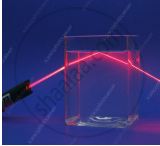
For the same angle of incidence, the angle of refraction in four media A, B, C and D are 25°, 30°, 35° and 40° respectively. The speed of light is least in medium ______.
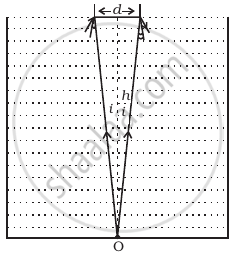
A jar of height h is filled with a transparent liquid of refractive index µ (Figure). At the centre of the jar on the bottom surface is a dot. Find the minimum diameter of a disc, such that when placed on the top surface symmetrically about the centre, the dot is invisible.
Small air bubbles rising up a fish tank appear silvery when viewed from some particular angle is due to the ______.
