Advertisements
Advertisements
प्रश्न
What is total internal reflection?
Explain total internal reflection of light.
Advertisements
उत्तर
Total internal reflection is the phenomenon when a ray of light travelling in a denser medium is incident at the surface of a rarer medium such that the angle of incidence is greater than the critical angle for the pair of media, and the ray is totally reflected back into the denser medium.
संबंधित प्रश्न
Angle of deviation is the angle which the ______ ray makes with the direction of ______ray.
State two conditions necessary for total internal reflection to occur.
Total internal reflection occurs only when a ray of light passes from a ______ medium to a ______ medium.
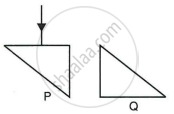
Two isosceles right-angle glass prisms P and Q are placed near each other as shown in Fig. Complete the path of the light ray entering the prism P till it emerges out of the prism Q.
Swarali has got the following observations while doing an experiment. Answer her questions with the help of observations.
Swarali observed that the light bent away from the normal, while travelling from dense medium to rarer medium. When Swarali increased the values of angle of incidence (i), the values of angle of refraction (r) went on increasing. But at a certain angle of incidence, the light rays returned into the dense medium.
So, Swarali has some questions. Answer them –
a) Name this certain value of ‘i ’. What is the value of ‘r’ at that time ?
b) Name this process of returning of light in dense medium. Explain the process.
Plot a graph between
Angle of incidence versus angle of reflection,
Plot a graph between
Angle of incidence versus angle of refraction.
How does a ray of light bend when it travels from denser to rarer medium.
Name the factors affecting the critical angle for the pair of media.
Complete the following diagram to show the path of the ray of a single colour in the diagram as if enters in and emerges out of the prism. Mark the angles wherever necessary. (Critical angle for glass = 42°).

Choose the correct option.
Select the WRONG statement.
A particle is projected such that the horizontal range and vertical height are equal. Then the angle of projection is :
Write any two uses of total internal reflection.
A green light is incident from the water to the air-water interface at the critical angle (θ). Select the correct statement.
A ray of light incident at an angle θ on a refracting face of a prism emerges from the other face normally. If the angle of the prism is 5° and the prism is made of a material of refractive index 1.5, the angle of incidence is ______.
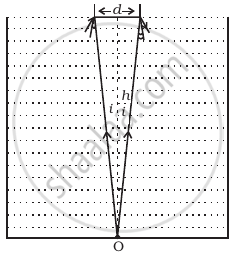
A jar of height h is filled with a transparent liquid of refractive index µ (Figure). At the centre of the jar on the bottom surface is a dot. Find the minimum diameter of a disc, such that when placed on the top surface symmetrically about the centre, the dot is invisible.
The angle made by incident ray of light with normal of the reflecting surface is called ______.
State two differences between normal reflection and total internal reflection.
If even one of the two required conditions for total internal reflection is missing, then:
