Advertisements
Advertisements
प्रश्न
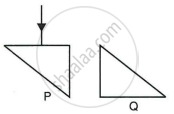
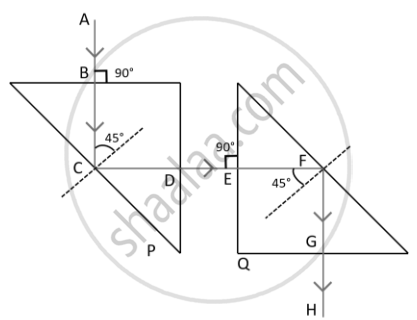
Two isosceles right-angle glass prisms P and Q are placed near each other as shown in Fig. Complete the path of the light ray entering the prism P till it emerges out of the prism Q.
Advertisements
उत्तर
संबंधित प्रश्न
A light ray does not bend at the boundary in passing from one medium to the other medium if the angle of incident is ______.
State two conditions necessary for total internal reflection to occur.
Total internal reflection occurs only when a ray of light passes from a ______ medium to a ______ medium.
Name the principle on the basis of which optical fibres work.
What is meant by the term ‘critical angle’?
Draw a diagram, properly labelled, to illustrate the use of a total reflecting prism (a right-angled isosceles prism) to turn a ray of light through 180°. Name an instrument in which this device is used.
Choose the correct option.
Angles of deviation for extreme colours are given for different prisms. Select the one having maximum dispersive power of its material.
A particle is projected such that the horizontal range and vertical height are equal. Then the angle of projection is :
A rectangular block of glass ABCD has a refractive index 1.6. A pin is placed midway on the face AB (Figure). When observed from the face AD, the pin shall ______.
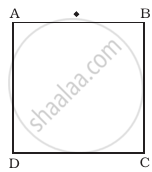
- appear to be near A.
- appear to be near D.
- appear to be at the centre of AD.
- not be seen at all.
When the angle of incidence for light travelling from a denser medium to a rarer medium is greater than the critical angle, the result is:
