Advertisements
Advertisements
प्रश्न
A light ray does not bend at the boundary in passing from one medium to the other medium if the angle of incident is ______.
पर्याय
0°
45°
60°
90°
Advertisements
उत्तर
A light ray does not bend at the boundary in passing from one medium to the other medium if the angle of incident is 0°.
APPEARS IN
संबंधित प्रश्न
Which colour of light has a higher critical angle? Red light or green light.
What do you understand by the deviation produced by a prism? Why is it caused?
Express the refractive index μ of a medium in terms of the angle of incidence i in air and the angle of refraction r in a denser medium.
Complete the following diagram to show the path of the ray of a single colour in the diagram as if enters in and emerges out of the prism. Mark the angles wherever necessary. (Critical angle for glass = 42°).
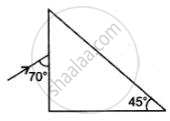
Explain ‘mirage’ as an illustration of refraction.
Answer the following question.
Under what conditions are total internal reflection possible? Explain it with a suitable example.
Describe the construction and working of an optical fibre.
The twinkling effect of star light is due to ______.
- Assertion (A): Propagation of light through an optical fibre is due to total internal reflection taking place at the core-cladding interface.
- Reason (R): Refractive index of the material of the cladding of the optical fibre is greater than that of the core.
The critical angle for water, which has a refractive index of 1.33, is:
