Advertisements
Advertisements
प्रश्न
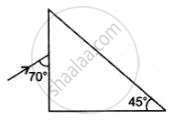
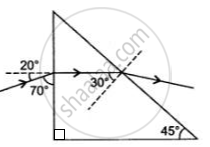
Complete the following diagram to show the path of the ray of a single colour in the diagram as if enters in and emerges out of the prism. Mark the angles wherever necessary. (Critical angle for glass = 42°).
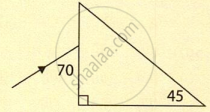
Copy and complete the following diagram to show the path of the ray of monochromatic light as it enters and emerges from the prism. Mark the angle wherever necessary (critical angle is 42°).
Advertisements
उत्तर
APPEARS IN
संबंधित प्रश्न
You are given prisms made of crown glass and flint glass with a wide variety of angles. Suggest a combination of prisms which will
(a) deviate a pencil of white light without much dispersion,
(b) disperse (and displace) a pencil of white light without much deviation.
Draw the diagram of a right-angled isosceles prism which is used to make an invented image erect.
Name the principle on the basis of which optical fibres work.
A ray of light incident at an angle of incidence ‘i’ passes through an equilateral glass prism such that the refracted ray inside the prism is parallel to its base and emerges from the prism at an angle of emergence ‘e’.
What can you say about the value of the angle of deviation in such a situation?
State one factor on which a critical angle for a given pair of media depends. The critical angle for the glass-air interface is 45° for the yellow light. Will it be equal to, less than or greater than 45° for (i) red light, (ii) blue light?
Which of the following is not involved in formation of a rainbow?
For a ray of light, the critical angle is minimum when it travels from ______.
Optical fibre communication uses the principle of ______.
What are the conditions to achieve total internal reflection?
Small air bubbles rising up a fish tank appear silvery when viewed from some particular angle is due to the ______.
