Advertisements
Advertisements
प्रश्न
Which of the following is not involved in formation of a rainbow?
पर्याय
refraction
angular dispersion
angular deviation
total internal reflection
Advertisements
उत्तर
Angular deviation
Explanation:
A rainbow is created when raindrops that are suspended in the air scatter sunlight. We perceive a rainbow because of the way light refracts when it enters a raindrop, total internal reflection from the rear of the droplet surface, and further refracted out in the atmosphere. So all the given processes, i.e., total internal reflection, refraction, and dispersion, take place in the rainbow formation. Angular deviation of light doesn't occur in the formation of a rainbow.
APPEARS IN
संबंधित प्रश्न
You are given prisms made of crown glass and flint glass with a wide variety of angles. Suggest a combination of prisms which will
(a) deviate a pencil of white light without much dispersion,
(b) disperse (and displace) a pencil of white light without much deviation.
Which colour of light has a higher critical angle? Red light or green light.
What do you understand by the deviation produced by a prism? Why is it caused?
Name two factors which affect the critical angle for a given pair of media. State how do the factors affect it.
One day Chetan’s mother developed a severe stomach ache all of a sudden. She was rushed to the doctor who suggested for an immediate endoscopy test and gave an estimate of expenditure for the same. Chetan immediately contacted his class teacher and shared the information with her. The class teacher arranged for the money and rushed to the hospital. On realizing that Chetan belonged to a below average income group family, even the doctor offered concession for the test fee. The test was conducted successfully.
Answer the following questions based on the above information:
(a) Which principle in optics is made use of in endoscopy?
(b) Briefly explain the values reflected in the action taken by the teacher.
(c) In what way do you appreciate the response of the doctor on the given situation?
Prove the statement.
A rainbow is the combined effect of the refraction, dispersion, and total internal reflection of light.
Define critical angle for a given medium.
Make the correct choices for each of the following :
Total Internal reflection takes place when
(where ∠i = angle of incidence, ∠r = angle of refraction, ∠C = critical angle)
Name the principle on the basis of which optical fibres work.
How does a ray of light bend when it travels from when it is normal to the interface of the two media.
State one factor on which a critical angle for a given pair of media depends. The critical angle for the glass-air interface is 45° for the yellow light. Will it be equal to, less than or greater than 45° for (i) red light, (ii) blue light?
What is meant by the statement, ‘the critical angle for diamond is 24°’?
Choose the correct option.
Angles of deviation for extreme colours are given for different prisms. Select the one having maximum dispersive power of its material.
Explain ‘mirage’ as an illustration of refraction.
Answer the following question.
Define the critical angle of incidence and obtain an expression for it.
Critical angle of light passing from glass to air is maximum for ____________.
Optical fibre communication uses the principle of ______.
The twinkling effect of star light is due to ______.
A ray of light passes from vacuum into a medium of refractive index µ, the angle of incidence is found to be twice the angle of refraction. Then the angle of incidence is ______.
The angle made by incident ray of light with normal of the reflecting surface is called ______.
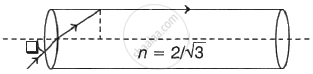
Find the value of θ in the given figure.
Name any two phenomena which take place in the formation of a rainbow.
An endoscope uses optic fiber to transmit high resolution images of internal organs without loss of information. The principle of light that is used by the optic fiber is based on ______.
State two differences between normal reflection and total internal reflection.
If even one of the two required conditions for total internal reflection is missing, then:
When the angle of incidence for light travelling from a denser medium to a rarer medium is greater than the critical angle, the result is:
The critical angle for crown glass, which has a refractive index of 1.52, is:
