Advertisements
Advertisements
प्रश्न
A ray of light is incident on a glass surface at an angle of 50° with the corresponding angle of refraction 30°. Find the value of the R.I. of glass.
Advertisements
उत्तर
R.I. = `sin"i"/sin"r"`
aμg = `sin"i"/sin"r"=(sin50°)/(sin30°)` ..........(∠i = 50° and ∠r = 30°)
= `0.7660/0.5000`
aμg = 0.1532.
संबंधित प्रश्न
Write the necessary conditions for the phenomenon of total internal reflection to
occur ?
Swarali has got the following observations while doing an experiment. Answer her questions with the help of observations.
Swarali observed that the light bent away from the normal, while travelling from dense medium to rarer medium. When Swarali increased the values of angle of incidence (i), the values of angle of refraction (r) went on increasing. But at a certain angle of incidence, the light rays returned into the dense medium.
So, Swarali has some questions. Answer them –
a) Name this certain value of ‘i ’. What is the value of ‘r’ at that time ?
b) Name this process of returning of light in dense medium. Explain the process.
Solve the previous problem if the paperweight is inverted at its place so that the spherical surface touches the paper.
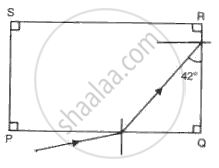
(a) A ray of monochromatic light enters glass PQRS as shown in the fig. Complete the path of ray till it emerges from the glass. (Critical angle of glass is 420).
(b) Draw diagram of a prism periscope.
(c) What are the advantages of total internal reflecting prism over plane mirror?
Answer the following question.
Define the critical angle of incidence and obtain an expression for it.
For a ray of light, the critical angle is minimum when it travels from ______.
Optical fibre communication uses the principle of ______.
A particle is projected such that the horizontal range and vertical height are equal. Then the angle of projection is :
State two differences between normal reflection and total internal reflection.
