Advertisements
Advertisements
प्रश्न
The diagram below shows a light source P embedded in a rectangular glass block ABCD of critical angle 42°. Complete the path of the ray PQ till it emerges out of the block. [Write necessary angles].

Advertisements
उत्तर
Given, critical angle, C = 42°
At a point Q, i = 48° and iC = 42°
i.e. i > iC
r = 48°
At a point P, i = 42° and iC = 42°
i = iC
Therefore, r = 90°

APPEARS IN
संबंधित प्रश्न
State the relation between the critical angle and the absolute refractive index of a medium.
Plot a graph between
Angle of incidence versus angle of reflection,
The adjacent diagram shows two right-angled isosceles prisms A and B. Complete the diagram to show the path of rays P and Q emerging out of the prism B. What principles have you used to complete the diagram?

For the same angle of incidence, the angle of refraction in four media A, B, C and D are 25°, 30°, 35° and 40° respectively. The speed of light is least in medium ______.
Optical fibre communication uses the principle of ______.
A rectangular block of glass ABCD has a refractive index 1.6. A pin is placed midway on the face AB (Figure). When observed from the face AD, the pin shall ______.
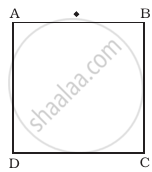
- appear to be near A.
- appear to be near D.
- appear to be at the centre of AD.
- not be seen at all.
A ray of light passes from vacuum into a medium of refractive index µ, the angle of incidence is found to be twice the angle of refraction. Then the angle of incidence is ______.
The diagram below shows a fish in the tank and its image seen on the surface of the water.
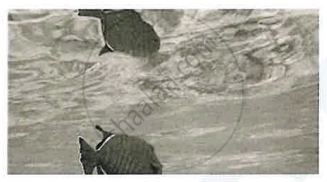
Name the phenomenon responsible for the formation of this image.
If even one of the two required conditions for total internal reflection is missing, then:
