Advertisements
Advertisements
प्रश्न
The diagram below shows a light source P embedded in a rectangular glass block ABCD of critical angle 42°. Complete the path of the ray PQ till it emerges out of the block. [Write necessary angles].

Advertisements
उत्तर
Given, critical angle, C = 42°
At a point Q, i = 48° and iC = 42°
i.e. i > iC
r = 48°
At a point P, i = 42° and iC = 42°
i = iC
Therefore, r = 90°

APPEARS IN
संबंधित प्रश्न
The diagram below shows a point source P inside a water container. Four rays A, B, C, D starting from the source P, are shown up to the water surface.
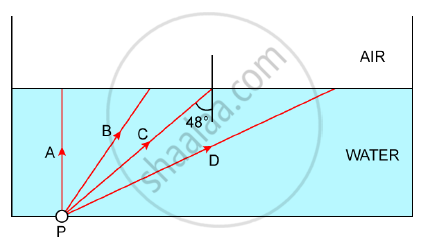
- Show in the diagram the path of these rays after striking the water surface. The Critical Angle for the water-air surface is 48°.
- Name the phenomenon which the rays B and D exhibit.
Draw diagram to illustrate the total internal reflection.
Write down the relationship between the critical angle and the refractive index of the medium.
How are critical angles related to the refractive index of the medium?
What is meant by the term ‘critical angle’?
The diagram shows a point source P inside a water container. Three rays A, B, and C starting from P are shown up to the water surface. Show in the diagram the path of these rays after striking the water surface. The critical angle for the water-air pair is 48°.

Choose the correct option.
Angles of deviation for extreme colours are given for different prisms. Select the one having maximum dispersive power of its material.
Total internal reflection can take place only if light is travelling from ______.
An endoscope uses optic fiber to transmit high resolution images of internal organs without loss of information. The principle of light that is used by the optic fiber is based on ______.
State two differences between normal reflection and total internal reflection.
