Advertisements
Advertisements
प्रश्न
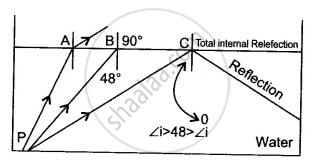
The diagram shows a point source P inside a water container. Three rays A, B, and C starting from P are shown up to the water surface. Show in the diagram the path of these rays after striking the water surface. The critical angle for the water-air pair is 48°.

Advertisements
उत्तर
संबंधित प्रश्न
The diagram below shows a light source P embedded in a rectangular glass block ABCD of critical angle 42°. Complete the path of the ray PQ till it emerges out of the block. [Write necessary angles].

Plot a graph between
Sine of angle of incidence versus sine of angle of refraction,
Name the principle on the basis of which optical fibres work.
Can light be ‘piped’ like sound in a doctor’s stethoscope?
A ray of light incident at an angle of incidence ‘i’ passes through an equilateral glass prism such that the refracted ray inside the prism is parallel to its base and emerges from the prism at an angle of emergence ‘e’.
How is the angle of emergence ‘e’ related to the angle of incidence ‘i’?
How is the critical angle of a material related to its refractive index?
A spherical marble, of refractive index 1.5 and curvature 1.5 cm, contains a tiny air bubble at its centre. Where will it appear when seen from outside?
The critical angle is defined as the angle of incidence at which the total internal reflection starts to occur.
A Rainbow is a beautiful natural phenomenon formed because of the following:
Find the value of θ in the given figure.