Advertisements
Advertisements
प्रश्न
Can light be ‘piped’ like sound in a doctor’s stethoscope?
Advertisements
उत्तर
Yes, light can be piped from one end to the other with little loss by allowing it to enter one end of a rod of transparent material. The light will undergo total internal reflection at the wall of the rod and will proceed along its axis. This actually being achieved by using a bundle of glass fibers.
APPEARS IN
संबंधित प्रश्न
The observation made by Swarali while doing the experiment is given below. Based on these write answers to the questions:
Swarali found that the light ray travelling from the denser medium to rarer medium goes away from the normal. If the angle of incidence (i) is raised by Swarali, the angle of refraction (r) went on increasing. However, after certain value of the angle of incidence the light ray is seen to return back into the denser medium.
Questions:
- What is the specific value of∠i called?
- What is the process of reflection of incident rays into denser medium called?
- Draw the diagrams of three observations made by Swarali.
Make the correct choices for each of the following :
Total Internal reflection takes place when
(where ∠i = angle of incidence, ∠r = angle of refraction, ∠C = critical angle)
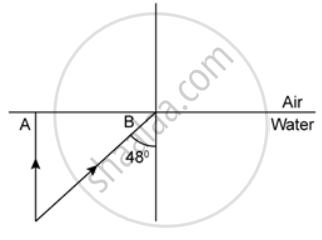
In the following figure, show two rays A and B travelling from water to air. If the critical angle for water- air surface is 48°, complete the ray diagram showing the refracted rays for each. State conditions when the ray will suffer total internal reflection.
If a ray of light passes from medium I to medium II without any change of direction, what can be said about the refractive indices of these media (angle I is not 0)?
A ray of light is incident as a normal ray on the surface of separation of two different mediums. What is the value of the angle of incidence in this case?
Solve Numerical example.
From the given data set, determine angular dispersion by the prism and dispersive power of its material for extreme colours. nR = 1.62 nV = 1.66, δR = 3.1°
A green light is incident from the water to the air-water interface at the critical angle (C). Select the correct statement.
A particle is projected such that the horizontal range and vertical height are equal. Then the angle of projection is :
- Assertion (A): Propagation of light through an optical fibre is due to total internal reflection taking place at the core-cladding interface.
- Reason (R): Refractive index of the material of the cladding of the optical fibre is greater than that of the core.
