Advertisements
Advertisements
प्रश्न
Can light be ‘piped’ like sound in a doctor’s stethoscope?
Advertisements
उत्तर
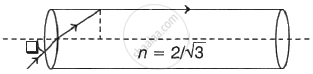
Yes, light can be piped from one end to the other with little loss by allowing it to enter one end of a rod of transparent material. The light will undergo total internal reflection at the wall of the rod and will proceed along its axis. This actually being achieved by using a bundle of glass fibers.
APPEARS IN
संबंधित प्रश्न
Angle of deviation is the angle which the ______ ray makes with the direction of ______ray.
In the given figure PQ and PR are the two light rays emerging from an object P. The ray PQ is refracted as QS.

- State the special name given to the angle of incidence ∠PQN of the ray PQ.
- What is the angle of refraction for the refracted ray QS?
- Name the phenomenon that occurs if the angle of incidence ∠PQN is increased.
- The ray PR suffers partial reflection and refraction on the water-air surface. Give reason.
- Draw in the diagram the refracted ray for the incident ray PR and hence show the position of image of the object P by the letter P’ when seen vertically from above.
Define critical angle for a given medium.
Plot a graph between
Angle of incidence versus angle of refraction.
For the same angle of incidence, the angle of refraction in four media A, B, C and D are 25°, 30°, 35° and 40° respectively. The speed of light is least in medium ______.
The twinkling effect of star light is due to ______.
The entire light is reflected back into the denser medium is called ______.
Which of the following statements about total internal reflection is true?
Find the value of θ in the given figure.