Advertisements
Advertisements
प्रश्न
Define critical angle for a given medium.
Advertisements
उत्तर
When a ray of light propagates from a denser medium to a rarer medium, the angle of incidence for which the angle of refraction is 90° is called the critical angle.
APPEARS IN
संबंधित प्रश्न
Name two factors which affect the critical angle for a given pair of media. State how do the factors affect it.
Calculate the speed of light in a medium whose critical angle is 30° ?
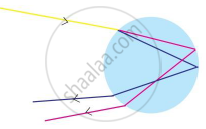
i) Observe the given figure and answer the following questions.
a) Identify and write the natural process shown in the figure.
b) List the phenomena which are observe in this process.
c) Redraw the diagram and show above phenomena in it.
A ray of light incident at an angle of incidence ‘i’ passes through an equilateral glass prism such that the refracted ray inside the prism is parallel to its base and emerges from the prism at an angle of emergence ‘e’.
What can you say about the value of the angle of deviation in such a situation?
Solve Numerical example.
A monochromatic ray of light is incident at 37° on an equilateral prism of refractive index 3/2. Determine angle of emergence and angle of deviation. If angle of prism is adjustable, what should its value be for emergent rays to be just possible for the same angle of incidence?
A green light is incident from the water to the air-water interface at the critical angle (C). Select the correct statement.
A particle is projected such that the horizontal range and vertical height are equal. Then the angle of projection is :
The outer concentric shell in optic fiber is called ______.
A ray of light incident at an angle θ on a refracting face of a prism emerges from the other face normally. If the angle of the prism is 5° and the prism is made of a material of refractive index 1.5, the angle of incidence is ______.
When the angle of incidence for light travelling from a denser medium to a rarer medium is greater than the critical angle, the result is:
