Advertisements
Online Mock Tests
Chapters
2: Work, Power and Energy
3: Machines
▶ 4: Refraction of Light at Plane Surfaces
5: Refraction of Light through Lenses
6: Spectrum
7: Sound
8: Current Electricity
9: Household Circuits
10: Electromagnetism
11: Heat
12: Modern Physics
![Lakhmir Singh solutions for फिज़िक्स [अंग्रेजी] कक्षा १० आईसीएसई chapter 4 - Refraction of Light at Plane Surfaces - Shaalaa.com](/images/physics-english-class-10-icse_6:bfbcc704031b4fd398b72f80ee978e3f.jpg "Lakhmir Singh solutions for फिज़िक्स [अंग्रेजी] कक्षा १० आईसीएसई chapter 4 - Refraction of Light at Plane Surfaces")
Advertisements
Solutions for Chapter 4: Refraction of Light at Plane Surfaces
Below listed, you can find solutions for Chapter 4 of CISCE Lakhmir Singh for फिज़िक्स [अंग्रेजी] कक्षा १० आईसीएसई.
Lakhmir Singh solutions for फिज़िक्स [अंग्रेजी] कक्षा १० आईसीएसई 4 Refraction of Light at Plane Surfaces Intex Question [Pages 84 - 97]
TEST YOUR UNDERSTANDING - 1
Explain the bending of a ray of light when it travels from a rarer to a denser medium.
Explain the bending of a ray of light when it travels from a denser to a rarer medium.
Explain the bending of a ray of light when it travels from the normal to the junction of the two media.
The refractive index of diamond is 2.42. What is the meaning of this statement?
State the Snell’s laws of refraction of light.
How does the speed of light in glass change on increasing the wavelength of light?
When a ray of light enters from one medium to another having different optical densities it bends. Why does this phenomenon occur?
A ray of monochromatic light is incident from the air on a glass slab:
(i) Draw a labelled ray diagram showing the change in the path of the ray till it emerges from the glass slab.
(ii) Name the two rays that are parallel to each other.
(iii) Mark the lateral displacement in your diagram.
Write the relation between the angle of incidence and the angle of refraction for a medium.
How is the refractive index of a material related to the speed of light in it?
What is the unit of refractive index?
The refractive index of glass with respect to air is aμg and that of water with respect to air is aμw. Write the expression for the refractive index of glass with respect to water.
Fill in the blanks with suitable answer:
When a ray of light goes from air into a clear material, you see the ray bend. How much the ray bends is determined by the ______ of the material.
When light travels from a rarer to a denser medium, its speed ______.
TEST YOUR UNDERSTANDING - 2
Define the term angle of deviation.
State three factors on which the angle of deviation depends.
Draw a ray diagram to show the refraction of a monochromatic ray through a prism when it suffers minimum deviation.
Choose the correct option for the following question.
A ray of light passes through an equilateral prism such that the angle of incidence is equal to the angle of emergence and each of these is equal to `3/4` of the angle of the prism. The angle of deviation is:
45°
29°
30°
20°
How does the angle of deviation produced by a prism depend on the colour of light used? Which colour of white light is deviated (i) most, (ii) least, by a prism?
A prism deviates a monochromatic ray of light through an angle d, where the angle of incidence at the surface of the prism is i. Draw a graph showing the variation of d with i. On your graph, show the angle of minimum deviation.
THINK AND ANSWER
What do you notice when you place a beaker of water on top of a printed paper? How does the letters on the paper look like through the beaker?
THINK AND ANSWER
Explain why the planets do not twinkle but the stars twinkle.
TEST YOUR UNDERSTANDING - 3
Jatin puts a pencil into a glass container having water and is surprised to see the pencil in a different state.
- What change is observed in the appearance of the pencil?
- Name the phenomenon responsible for the change.
- Draw a ray diagram showing how the eye sees the pencil.
A fish swimming in a pond seems nearer than it really is. Explain.
How is the refractive index of a medium related to its real depth and apparent depth?
Does the depth of a tank of water appear to change or remain the same when viewed normally from above?
A glass slab is placed over a piece of paper on which VIBGYOR is printed with each letter in its corresponding colour.
- Will the images of all the letters be in the same place?
- The letter of which colour appears to be raised maximum and of which colour minimum? Explain your answer.
THINK AND ANSWER
Can light be ‘piped’ like sound in a doctor’s stethoscope?
TEST YOUR UNDERSTANDING - 4
Define the term ‘critical angle’.
How is the critical angle related to the refractive index of a medium?
What is total internal reflection?
Why upper surface of water contained in a beaker and above eye level appears silvery?
State the conditions required for total internal reflection of light to take place.
Mention one difference between reflection of light from a plane mirror and total internal reflection of light from a prism.
Name the factors affecting the critical angle for the pair of media.
State three actions that a total reflecting prism can produce.
Lakhmir Singh solutions for फिज़िक्स [अंग्रेजी] कक्षा १० आईसीएसई 4 Refraction of Light at Plane Surfaces EXERCISE [Pages 99 - 106]
Objective Questions
State whether the following statement is true or false:
Refraction occurs because light slows down in denser materials.
True or False.
The frequency of light changes during refraction.
If the angle of incidence is greater than the critical angle, light is not refracted at all, when it falls on the surface from a denser medium to a rarer medium.
True
False
The deviation produced by a prism is independent of the angle of incidence and is same for all the colours of light.
True
False
True or False.
In total internal reflection, there is a loss of energy.
True or False.
The depth of a tank of water appears to change when viewed normally from the above.
Fill in the Blanks
A medium is said to be optically ______ if the speed of light slows down in it.
When a ray of light goes from air into a clear material, you see the ray bend. How much the ray bends is determined by the ______ of the material.
Light bends when it travels from water into air. We say that it is ______.
When a ray of light enters a prism, it bends ______ the normal; as it leaves the prism, it bends ______ the normal.
Total internal reflection takes place when a light ray propagates from ______ to ______ medium.
Multiple Choice Questions
For which colour, the refractive index of glass is maximum?
Red
Violet
Green
Yellow
The refractive indices of four media A, B, C and D are 1.44, 1.52, 1.65 and 1.36 respectively. When light travelling in air is incident in these media at equal angles, the angle of refraction will be the minimum ______.
in medium A
in medium B
in medium C
in medium D
Diamonds glitter in the dark because ______.
they emit light
they have a very small critical angle due to very high refractive index
they exhibit fluorescence
the chemical reaction in the diamond produces light energy
A ray of light is incident on a parallel-sided glass slab, as shown in the diagram. The angle of refraction for this ray of light is likely to be:
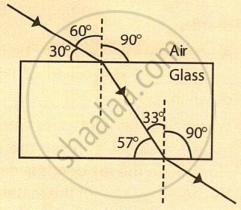
60°
33°
57°
30°
Which of the following remains constant during refraction?
Wavelength
Frequency
Amplitude
Speed
A ray of light is incident as a normal ray on the surface of the separation of two different media. What is the value of the angle of incidence in this case?
90°
45°
60°
0°
A ray of light travelling in air is incident on the plane of a transparent medium. The angle of incidence is 45° and that of refraction is 30°. Find the index of the medium.
2
`1/sqrt2`
`2/sqrt2`
`sqrt2`
Refractive index of diamond with respect to glass is 1.6 and the absolute refractive index of glass is 1.5, then the absolute refractive index of diamond is:
1.4
2.4
3.4
1
When a ray of light travelling in glass enters into water obliquely ______.
it is refracted towards the normal
it is not refracted at all
it goes along the normal
it is refracted away from the normal
A ray of light travels from glass into air. The angle of refraction will be ______.
equal to the angle of incidence
greater than the angle of incidence
smaller than the angle of incidence
45°
Match the following columns and choose the correct answer using the codes.
| Column I | Column II |
| A. The angle of deviation of a prism depends on | (i) Refraction |
| B. The refractive index of a medium is equal to the reciprocal of the sine of its | (ii) Total internal reflection |
| C. Optical fibre | (iii) Angle of incidence |
| D. Twinkling of stars | (iv) Critical angle |
A - (iv), B - (iii), C - (i), D - (ii)
A - (iv), B - (iii), C - (ii), D - (i)
A - (iii), B - (iv), C - (ii), D - (i)
A - (i), B - (iv), C - (iii), D - (ii)
Descriptive Questions Short Answer Questions
What is meant by the refraction of light?
Refractive indices of carbon disulphide and ethyl alcohol are 1.63 and 1.36 respectively. Which is optically denser?
Name the phenomenon due to which a swimming pool appears less deep than it really is.
If a ray of light passes from medium I to medium II without any change of direction, what can be said about the refractive indices of these media (angle I is not 0)?
What is the difference between real depth and apparent depth?
When a ray of light travels from air to glass, at what angle of incidence, the ray will not be deviated?
A ray of light passes from water to air. How does the speed of light change?
Why is the ratio of the velocities of light of wavelengths 3000 Å and 5000 Å in vacuum 1 : 1?
State the dependence of angle of deviation on the refractive index of the material of the prism.
State the dependence of angle of deviation on the wavelength of light
Write one condition where it does not bend when entering a medium of different optical density.
Mention one difference between reflection of light from a plane mirror and total internal reflection of light from a prism.
Define the term refractive index of a medium. Can it be less than 1?
What is the speed of light in a vacuum?
Name the only medium in which the speed of light is equal to that of a vacuum.
Which of the following media has the highest and the least optical densities? Explain.
Media: glass, oil, diamond, air and water.
Draw a labelled ray diagram to show how a ray of light passes through a parallel-sided glass block if it hits the glass block at 90° (that is, perpendicular to the glass block).
Draw a labelled ray diagram to show how a ray of light passes through a parallel-sided glass block if it hits the glass block at an angle other than 90° (that is, obliquely to the glass block).
A ray of light incident at an angle of incidence ‘i’ passes through an equilateral glass prism such that the refracted ray inside the prism is parallel to its base and emerges from the prism at an angle of emergence ‘e’.
How is the angle of emergence ‘e’ related to the angle of incidence ‘i’?
A ray of light incident at an angle of incidence ‘i’ passes through an equilateral glass prism such that the refracted ray inside the prism is parallel to its base and emerges from the prism at an angle of emergence ‘e’.
What can you say about the value of the angle of deviation in such a situation?
Light passes through a rectangular glass slab and through a triangular glass prism. In what way does the direction of the two emergent beams differ and why?
The wavelengths for the light of red and blue colours are nearly 7·8 × 10-7 m and 4·8 × 10-7 m respectively.
Which colour has greater speed in glass?
State the laws of refraction of light.
Write a relation between the angle of incidence (i), angle of emergence (e), angle of the prism (A), and angle of deviation (d) for a ray of light passing through an equilateral prism.
A ray of monochromatic light enters a liquid from the air as shown in the diagram given below:
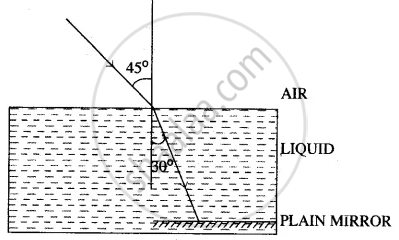
Copy the diagram and show in the diagram the path of the ray of light after it strikes the mirror and re-enters the medium of air.
A ray of monochromatic light enters a liquid from the air as shown in the diagram given below:
Mark in your diagram the two angles on the surface of separation when the ray of light moves out from the liquid to air.
A ray of light enters a glass slab PQRS as shown in the diagram. The critical angle of glass is 42°. Copy the following diagram and complete the path of the ray till it emerges from the glass slab. Mark the angles in the diagram wherever necessary.
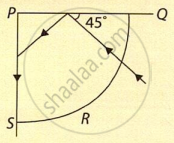
Complete the following diagram to show the path of the ray of a single colour in the diagram as if enters in and emerges out of the prism. Mark the angles wherever necessary. (Critical angle for glass = 42°).

Copy and complete the following diagram to show the path of the ray of monochromatic light as it enters and emerges from the prism. Mark the angle wherever necessary (critical angle is 42°).
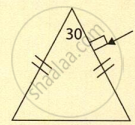
Complete the following diagram to show the path of the ray of a single colour in the diagram as if enters in and emerges out of the prism. Mark the angles wherever necessary. (Critical angle for glass = 42°).
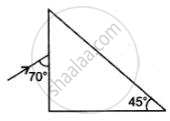
What is lateral displacement?
State two factors on which the lateral displacement of the emergent ray depends.
A boy uses the blue colour of light to find the refractive index of glass. He then repeats the experiment using the red colour of light. Will the refractive index be the same or different in the two cases? Give a reason to support your answer.
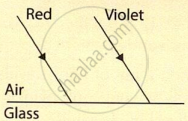
Two parallel rays of red and violet travelling through air meet the air-glass boundary as shown in the diagram. Will their paths inside the glass be parallel? Give a reason for your answer. Compare the speeds of the two rays inside the glass.
Copy the diagram given below and complete the path of the light ray till it emerges out of the prism. The critical angle of glass is 42°. In your diagram mark the angles wherever necessary.

A stick partly immersed in water appears to be bent. Draw a ray diagram to show the bending of the stick when placed in water and viewed obliquely from above.
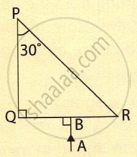
Complete the path of the ray AB through the glass prism in PQR till it emerges out of the prism. Given, the critical angle of glass is 42°.
Draw a labelled ray diagram to illustrate critical angle.
Draw a labelled ray diagram to illustrate total internal reflection for a ray of light moving from one medium to another.
Write a formula to express the relationship between the refractive index of the denser medium with respect to the rarer medium and its critical angle for that pair of media.
Long Answer Questions
The diagram shows the path of light through a right-angled prism of critical angle 42°. Observe the diagram and answer the questions that follow.
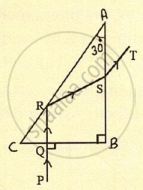
(i) Name the phenomenon at the surface of AС.
(ii) Determine the angle of incidence at the surface AC.
(ii) Determine the angle of incidence at the surface AB.
(iv) Which of the following statements is false?
- The speed of light ray PQ is equal to the speed of light ray ST.
- The speed of light ray QR is equal to the speed of light ray RS.
- The speed of light ray PQ is greater than the speed of light ray RS.
- The speed of light ray RQ is greater than the speed of light ray ST.
PQ and PR are two light rays emerging from the object as shown in the figure below:

(i) What is the special name given to the angle of incidence (∠PQN) of ray PQ?
(ii) Copy the ray diagram and complete it to show the position of the image of the object P when seen obliquely from above.
(iii) Name the phenomenon that occurs if the angle of incidence ∠PQN is increased still further.
The adjacent diagram shows two right-angled isosceles prisms A and B. Complete the diagram to show the path of rays P and Q emerging out of the prism B. What principles have you used to complete the diagram?

A monochromatic point source of light O is seen through a rectangular glass block ABCD. The paths of two rays, in and outside, the blocks are as shown in the diagram.
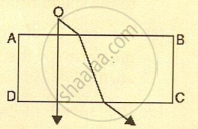
- Does the source appear to be nearer or farther with respect to surface AB?
- How does the shift depend upon the thickness AD or BC of the block?
- Justify your answer in (ii) with the help of a ray diagram.
- For the same rectangular block, which colour from the visible spectra will produce the maximum shift?
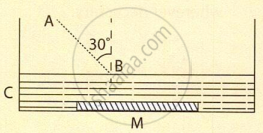
The diagram shows a container C partially filled with water. There is a plane mirror M at the bottom of the container. A light ray AB is incident on the surface of water at an angle of incidence of 30°. Copy and complete the ray diagram. Mark the ray emerging from the surface of water. Refractive index of water = `4/3`.
A diver in water looks obliquely at an object AB in air.
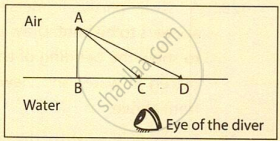
- Does the object appear taller, shorter or of the same size as the diver?
- Show the path of two rays AC and AD starting from the tip of the object as it travels towards the diver in water and hence obtain the image of the object.
(i) The diagram shows a ray of light incident on an equilateral glass prism placed in minimum deviation position.
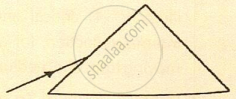
Copy the diagram and complete it to show the path of the refracted ray and the emergent ray.
(ii) How are angle of incidence and angle of emergence related to each other in this position of the prism?
The diagram below shows a point source P inside a water container. Four rays A, B, C, D starting from the source P, are shown up to the water surface.
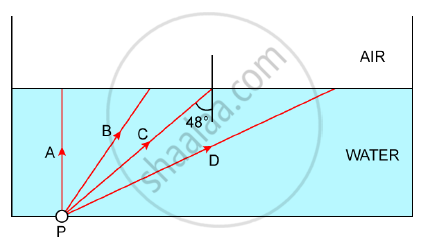
- Show in the diagram the path of these rays after striking the water surface. The Critical Angle for the water-air surface is 48°.
- Name the phenomenon which the rays B and D exhibit.
A ray of light PQ is incident normally on the hypotenuse of a right-angled prism ABC as shown in the diagram given below:

(i) Copy the diagram and complete the path of the ray PQ till it emerges from the prism.
(ii) What is the value of the angle of deviation of the ray?
(iii) Name an instrument where this action of the prism is used.
Numerical Problems
A ray of light is incident on a glass slab at an angle of incidence of 60°. If the angle of refraction be 32.7°, calculate the refractive index of glass.
(Given: sin 60° = 0.866 and sin 32.7° = 0.540.)
The speed of light in air is 3 × 10⁸ m s-1. Calculate the speed of light in glass. The refractive index of glass is 1.5.
A coin at the bottom of a trough containing water to a depth of 15 cm appears to be 3.75 cm raised above from the bottom. Calculate the refractive index of water.
Light travels through air at 300 million ms−1. On entering water it slows down to 225 million ms−1. Calculate the refractive index of water.
The absolute refractive index of diamond is 2.4. What is the speed of light in diamond?
A beam of monochromatic light is incident at an angle of incidence of 50° on one face of an equilateral prism. If the angle of emergence is 40°, what will be the angle of minimum deviation?
A light ray is moving from glass to air. Calculate the critical angle for the glass-air interface? Given, aμg = 1.5.
The depth of water in a bucket is 40 cm but its bottom appears to be raised by 10 cm. What is the refractive index of water?
When a container is completely filled with water `(μ_w = 4/3)`, its bottom appears to be raised by 4 cm. What is the actual depth of the container?
The velocity of light in a medium is 2.25 × 10⁸ m/s. What is the refractive index of this medium?
A light ray moves from glass (Vg = 2.0 × 10⁸ m/s) to diamond (Vd = 1.25 × 10⁸ m/s). What is the refractive index of diamond with respect to glass?
DO IT RIGHT
| Ramya is an 8-year-old girl who has just begun to learn swimming. At the moment, she is in the swimming pool. Suddenly, Ramya finds that her earring has fallen into the water. It appears to her that the earring has not gone too deep. So, she begins to go further into the swimming pool to retrieve her earring. Her trainer, who has been watching her movements, does not allow Ramya to go further and pulls her out of the swimming pool quickly. |
- Why does it appear to Ramya that her earring has not gone too deep in water? Name the phenomenon involved.
- Why does the trainer not allow Ramya to go further in the swimming pool?
- Give one example of the effect of phenomenon involved in the above episode in which a glass slab is used.
- What values does the trainer show in the above episode?
Solutions for 4: Refraction of Light at Plane Surfaces
Lakhmir Singh solutions for फिज़िक्स [अंग्रेजी] कक्षा १० आईसीएसई chapter 4 - Refraction of Light at Plane Surfaces
Shaalaa.com has the CISCE Mathematics फिज़िक्स [अंग्रेजी] कक्षा १० आईसीएसई CISCE solutions in a manner that help students grasp basic concepts better and faster. The detailed, step-by-step solutions will help you understand the concepts better and clarify any confusion. Lakhmir Singh solutions for Mathematics फिज़िक्स [अंग्रेजी] कक्षा १० आईसीएसई CISCE 4 (Refraction of Light at Plane Surfaces) include all questions with answers and detailed explanations. This will clear students' doubts about questions and improve their application skills while preparing for board exams.
Further, we at Shaalaa.com provide such solutions so students can prepare for written exams. Lakhmir Singh textbook solutions can be a core help for self-study and provide excellent self-help guidance for students.
Concepts covered in फिज़िक्स [अंग्रेजी] कक्षा १० आईसीएसई chapter 4 Refraction of Light at Plane Surfaces are .
Using Lakhmir Singh फिज़िक्स [अंग्रेजी] कक्षा १० आईसीएसई solutions Refraction of Light at Plane Surfaces exercise by students is an easy way to prepare for the exams, as they involve solutions arranged chapter-wise and also page-wise. The questions involved in Lakhmir Singh Solutions are essential questions that can be asked in the final exam. Maximum CISCE फिज़िक्स [अंग्रेजी] कक्षा १० आईसीएसई students prefer Lakhmir Singh Textbook Solutions to score more in exams.
Get the free view of Chapter 4, Refraction of Light at Plane Surfaces फिज़िक्स [अंग्रेजी] कक्षा १० आईसीएसई additional questions for Mathematics फिज़िक्स [अंग्रेजी] कक्षा १० आईसीएसई CISCE, and you can use Shaalaa.com to keep it handy for your exam preparation.
