Advertisements
Advertisements
प्रश्न
A ray of light PQ is incident normally on the hypotenuse of a right-angled prism ABC as shown in the diagram given below:

(i) Copy the diagram and complete the path of the ray PQ till it emerges from the prism.
(ii) What is the value of the angle of deviation of the ray?
(iii) Name an instrument where this action of the prism is used.
Advertisements
उत्तर
(i)
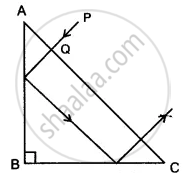
(ii) Angle of deviation of the ray = 180°.
(iii) Prism Binoculars.
APPEARS IN
संबंधित प्रश्न
State the dependence of angle of deviation on the wavelength of light
The speed of light in glass is 2 × 10⁵ km/s. What is the refractive index of glass?
In the adjacent diagram, AO is a ray of light incident on a rectangular glass slab.

- Complete the path of the ray till it emerges out of the slab.
- In the diagram, mark the angle of incidence (i) and the angle of refraction (r) at the first interface. How is the refractive index of glass related to the angles i and r?
- Mark angles of emergence by the letter e. How are the angles i and e related?
- Which two rays are parallel to each other? Name them.
- Indicate in the diagram the lateral displacement between the emergent ray and the incident ray. State one factor that affects the lateral displacement.
How does the speed of light change when it passes from glass to water?
Fill in the blank to complete the following sentence:
When light travels from a rarer to a denser medium, it bends ...........
The diagram shows the path of a ray of light through a rectangular glass block placed in a liquid of uniform density.

What is the angular, deviation of the emergent ray from the glass block with respect to the incident ray?
Trace a ray of light incident at 30° on a surface if travelling from air to glass. What is the angle of refraction in this case? (R.I. for glass = 3/2).
The velocity of light in diamond is 121000 kms-1. What is its refractive index?
Consider these indices of refraction: glass: 1.52; air: 1.0003; water: 1.333. Based on the refractive indices of three materials, arrange the speed of light through them in decreasing order.
