Advertisements
Advertisements
प्रश्न
Trace a ray of light incident at 30° on a surface if travelling from air to glass. What is the angle of refraction in this case? (R.I. for glass = 3/2).
Advertisements
उत्तर
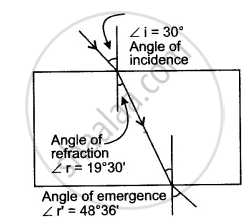
aμg = `sin"i"/sin"r"`
∴ `3/2=(sin30°)/sin"r"`
∴ Sin r = `2/3xxsin30°`
But sin 30° = `1/2`
∴ sin r = `2/3xx1/2`
= `1/3`
∴ sin r = 0.3334
∴ sin r = 19°30′.
Angle of refraction for air to glass = 19°30′.
संबंधित प्रश्न
In your laboratory you trace the path of light rays through a glass slab for different values of angle of incidence (∠i) and in each case measure the values of the corresponding angle of refraction (∠r) and angle of emergence (∠e). On the basis of your observations your correct conclusion is:
(a) ∠i is more than ∠r, but nearly equal to ∠e
(b) ∠i is less then ∠r, but nearly equal to ∠e
(c) ∠i is more than ∠e, but nearly equal to ∠r
(d) ∠i is less than ∠e, but nearly equal to ∠r
On the basis of the experiment, "To trace the path of a ray of light through a rectangular glass slab", students of a class arrived at which one of the following conclusions?
(A) Angle of incidence is greater than the angle of emergence.
(B) Angle of emergence is smaller than the angle of refraction.
(C) Emergent ray is parallel to the refracted ray.
(D) Incident ray and emergent ray are parallel to each other.
When a lighted candle is held in front of a thick plane glass mirror, several images can be seen, but the second image is the brightest, give reason.
A postage stamp kept below a rectangular glass block of refractive index 1.5 when viewed from vertically above it, appears to be raised by 7.0 mm. Calculate the thickness of the glass slab.
A ray of light strikes the surface at a rectangular glass slab such that the angle of incidence is 45o.
In each case, draw diagram to show the path taken by the ray as it passes through the glass slab and emerges from it.
What is the refractive index of vacuum
Calculate the velocity of light in a glass block of refractive index 1.5. (Velocity of light in air = 3 × 10⁸ m/s)

The refractive index of glass with respect to air is 3/2. What is the refractive index of air with respect to glass?
The diagram below shows two parallel rays A (Orange) & B (Blue) incident from air, on air-glass boundary.

- Copy and complete the path of the rays A and B.
- How do the speeds of these rays differ in glass?
- Are the two refracted rays in glass parallel? Give a reason.
