Advertisements
Advertisements
प्रश्न
Trace a ray of light incident at 30° on a surface if travelling from air to glass. What is the angle of refraction in this case? (R.I. for glass = 3/2).
Advertisements
उत्तर
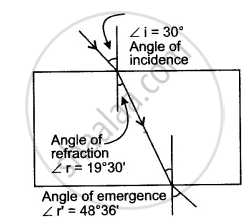
aμg = `sin"i"/sin"r"`
∴ `3/2=(sin30°)/sin"r"`
∴ Sin r = `2/3xxsin30°`
But sin 30° = `1/2`
∴ sin r = `2/3xx1/2`
= `1/3`
∴ sin r = 0.3334
∴ sin r = 19°30′.
Angle of refraction for air to glass = 19°30′.
संबंधित प्रश्न
State the dependence of angle of deviation on the wavelength of light
Draw the diagram of refraction of light in the glass slab
Why is the ratio of the velocities of light of wavelengths 4000Å and 8000Å in vacuum 1: 1?
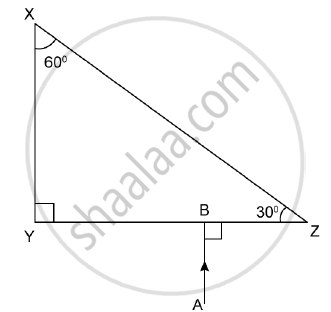
The following diagram shows a 60°, 30°, 90° glass prism of critical angle 42°, Copy the diagram and complete the path of incident ray AB emerging out of the prism marking the angle of incidence on each surface.
An object is viewed through a glass prism with its vertex pointing upwards. It appears to be displaced upward. Explain the reason.
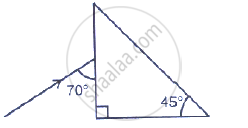
Complete Fig. 4.32 to show the path of the ray of single colour as it enters the prism and emerges out of it. Mark the angles wherever necessary.
In an experiment of finding the refractive index of glass, if blue light is replaced by the red light, how will the refractive index of glass change? Give reason in support of your answer.
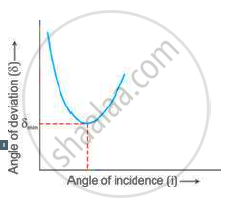
Using the curve, how do you infer that for given prism, the angle of minimum deviation δmin is unique for the given light?
What is the refractive index of vacuum
Comment on the statement ‘The refractive index of glass is 3/2.’
