Advertisements
Advertisements
Question
Trace a ray of light incident at 30° on a surface if travelling from air to glass. What is the angle of refraction in this case? (R.I. for glass = 3/2).
Advertisements
Solution
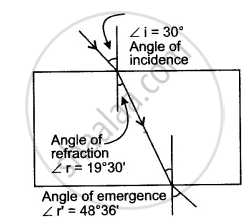
aμg = `sin"i"/sin"r"`
∴ `3/2=(sin30°)/sin"r"`
∴ Sin r = `2/3xxsin30°`
But sin 30° = `1/2`
∴ sin r = `2/3xx1/2`
= `1/3`
∴ sin r = 0.3334
∴ sin r = 19°30′.
Angle of refraction for air to glass = 19°30′.
RELATED QUESTIONS
Explain how spectrum is formed.
A student traces the path of a ray of light through a rectangular glass slab for the different values of angle of incidence. He observes all possible precautions at each step of the experiment. At the end of the experiment, on analyzing the measurements, which of the following conclusions is he likely to draw?
(A) ∠i = ∠e < ∠r
(B) ∠i < ∠e < ∠r
(C) ∠i > ∠e > ∠r
(D) ∠i = ∠e > ∠r
Four students P, Q, R and S traced the path of a ray of light passing through a glass slab for an angle of incidence 40° and measured the angle of refraction. The values as measured them were 18°; 22°; 25° and 30° respectively. The student who has performed the experiment methodically is
(A) P
(B) Q
(C) R
(D) S
Why is the ratio of the velocities of light of wavelengths 4000Å and 8000Å in vacuum 1: 1?
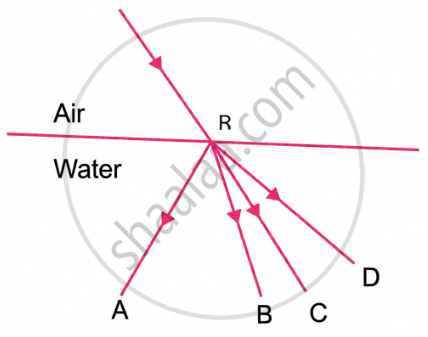
A ray of light passes from air to water. In fig., which of the ray A, B, C and D is the correct refracted ray?
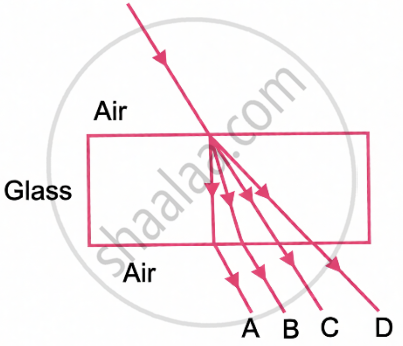
In the fig. name the ray which represents the correct path of light while passing through a glass block.
A fish swimming in a pond seems nearer than it really is. Explain.
Why does the sun appear bigger during sunset or sunrise?
A ray of light moves from a rare medium to a dense medium as shown in the diagram below. Write down the number of the ray which represents the partially reflected ray.

A glass block is having refractive index 3/2, the light ray is incident at an angle 45°. Find the sine of the angle of, refraction inside the glass block.
