मराठी
महाराष्ट्र राज्य शिक्षण मंडळएस.एस.सी (इंग्रजी माध्यम) इयत्ता १० वी

Draw the Diagram of Refraction of Light in Glass Slab

Advertisements
Advertisements

प्रश्न

Draw the diagram of refraction of light in the glass slab

Advertisements

उत्तर

shaalaa.com
  या प्रश्नात किंवा उत्तरात काही त्रुटी आहे का?
2017-2018 (March)

संबंधित प्रश्‍न

Write a short note on dispersion of light.


Draw a ray diagram to show the refraction of light through a glass slab and mark angle of refraction and the lateral shift suffered by the ray of light while passing through the slab.


State the dependence of angle of deviation On the wavelength of light


Name one factor that affects the lateral displacement of light as it passes through a rectangular glass slab.


A ray of light passes from water to air. How does the speed of light change?


Which of the above wavelengths has a higher frequency?


The following diagram shows a 60°, 30°, 90° glass prism of critical angle 42°, Copy the diagram and complete the path of incident ray AB emerging out of the prism marking the angle of incidence on each surface.


Draw diagrams to show the refraction of light from glass to air. In  diagram, label the incident ray, refracted ray, the angle of incidence (i) and the angle of refraction (r).


How does the angle of minimum deviation produces by a prism change with increase in : 

the refracting angle of prism? 


How does the speed of light change when it passes from glass to water? 


Fill in the blanks to complete the following sentence 

The refractive index of glass with respect to air is 3/2. The refractive index of air with respect to glass will be ………………. 


How is the angle of emergence related to the angle of incidence when prism is in the position of minimum deviation? Illustrate your answer with help of a labelled diagram using an equilateral prism? 


A coin is places at the bottom of a beaker containing water (refractive index = 4/3) to a depth of 12 cm. By what height the coin appears to be raised when seen from vertically above? 


A postage stamp kept below a rectangular glass block of refractive index 1.5 when viewed from vertically above it, appears to be raised by 7.0 mm. Calculate the thickness of the glass slab.


The refractive index of air with respect to glass is expressed as `""_g μ_a=sin i /sin r`.

  1. Write down a similar expression for aμg in terms of the angles i and r.
  2. If angle r = 90°, what is the corresponding angle i called?
  3. What is the physical significance of the angle i in part (b)? 

A ray of light enters a glass slab ABDC as shown in figure and strikes at the centre O of the circular part AC of the slab. The critical angle of glass is 42°. Complete the path of the ray till it emerges out from the slab. Mark the angles in the diagram wherever necessary. 


A total reflecting right angled isosceles prism can be used to deviate a ray of light through:
(a) 30° (b) 60° (c) 75° (d) 90°. 


Trace the path of a ray of light incident at an angle of 45° on a rectangular glass slab. Write the measure of the angle of refraction, the angle of emergence and the lateral displacement suffered by the ray as it passes through the slab. 


A student has traced the path of a ray of light through a glass slab as follows. If you are asked to label 1, 2, 3 and 4, the correct sequencing of labeling  ∠i, ∠e, ∠r and lateral displacement respectively is

(a) 2, 1, 3, 4

(b) 1, 2, 3, 4

(c) 1, 3, 2, 4

(d) 1, 3, 4, 2


Define the term refractive index of a medium. What do you understand by the statement 'the refractive index of glass is 1.5 for white light'?


In the fig., PO is a ray of light incident on a rectangular glass block.
(a)   Complete the path of the ray through the block.
(b)  In the diagram, mark the angle of incidence (i) and the angle of refraction (r) at the first interface. How is the refractive index of glass related to the angles I and r?
(c)  Mark angle of emergence by the letter e. How are the angles i and e related?
(d)  Which two rays are parallel to each other? Name them.
(e)  Indicate in the diagram the lateral displacement between the emergent ray and the incident ray.


Make the correct for each of the following : 

With reference to the fig, the refractive index of the glass block is 


Briefly, describe an experiment to show that a prism itself produces no colour.

What is meant by the refraction of light?


Why upper surface of water contained in a beaker and above eye level appears silvery?


Which colour of light travels fastest in any medium except air?


Name one main factor on which the direction of bending of a ray of light depends.


How is the refractive index of a medium related to its real depth and apparent depth?


Why does the sun appear bigger during sunset or sunrise?


Name two instruments of the total refracting prism in which is used.


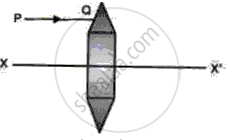
In the diagram below, PQ is a ray of light incident on a rectangular glass block.

Copy the diagram and complete the path of the ray of light through the glass block. In your diagram, mark the angle of incidence by letter ‘i’ and the angle of emergence by the letter ‘e’.


In the diagram below, PQ is a ray of light incident on a rectangular glass block.

How are the angles ‘i’ and ‘e’ related to each other?


After a robbery, if a window has been broken, there will be tiny particles of glass. Some of these will be found at the scene of the crime and some may be caught in the thief’s clothing. If the police can prove that these particles are identical, they have a strong case.
A method of doing this is to suspend the particles of glass in a special liquid. Light of a single colour is thrown through the liquid and the particles viewed through a microscope. The temperature of the liquid is then slowly altered. This alters the speed of light through the liquid (i.e., it alters the refractive index). At one particular temperature, the particles of glass disappear. It this happens at the same temperature for both sets of glass particles, they probably came from the same broken pane of glass.
Complete and copy the diagram to show how light bends when it travels from the liquid to the glass and back to the liquid, If the light slows down in the glass.


Trace a ray of light incident at 30° on a surface if travelling from glass to air. What is the angle of refraction in this case? (R.I. for glass = 3/2).


Draw a diagram of a prism and label:
(i) the base,
(ii) the refracting surfaces,
(iii) the refracting edge,
(iv) the refracting angle in it.


The speed of light in air is 3 × 10ms-1. Calculate the speed of light in water. The refractive index of water is 4/3.


The refractive index of glass with respect to air is 1.5. What is the value of the refractive index of air with respect to glass?


Share
Notifications

Englishहिंदीमराठी


      Forgot password?
Use app×