Advertisements
Advertisements
प्रश्न
The diagram shows the path of a ray of light through a rectangular glass block placed in a liquid of uniform density.

(a) Does the light speed up or slow down in the glass,
(b) Give the reason for your answer.
Advertisements
उत्तर
(a) The speed of light, travelling from liquid to glass, slow down.
(b) Speed in liquids = `"Speed of light of air"/"Refractive index of liquid"=(3xx10^8)/"Refractive index of liquid"`
Speed of light in glass = `"Speed of light in air"/"Refractive index of glass"=(3xx10^8)/"Refractive index of glass"`
Since the refractive index in glass is usually higher than that of liquid, hence the speed of light in glass will be less.
संबंधित प्रश्न
How must light travel out of a substance if it is not going to be refracted?
The highest refractive index is of ______.
A student has traced the path of a ray of light through a glass slab as follows. If you are asked to label 1, 2, 3 and 4, the correct sequencing of labeling ∠i, ∠e, ∠r and lateral displacement respectively is
(a) 2, 1, 3, 4
(b) 1, 2, 3, 4
(c) 1, 3, 2, 4
(d) 1, 3, 4, 2
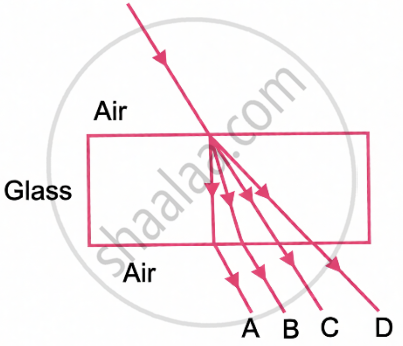
In the fig. name the ray which represents the correct path of light while passing through a glass block.
A fish swimming in a pond seems nearer than it really is. Explain.
What should be the ratio of the speed of light through the liquid to the speed through the glass so that there is no refraction of light at the boundaries of the glass block when the system is illuminated by the light of one colour?
Comment on the statement ‘The refractive index of glass is 3/2.’
Express the refractive index μ of a medium in terms of the velocity of light.
The diagram shows the path of a ray of light through a rectangular glass block placed in a liquid of uniform density.
What should be the rate of the speed of light through the liquid to the speed through the glass so that there is no refraction of light at the boundaries of the glass block when the system is illuminated by the light of one colour?
