Advertisements
Advertisements
Question
The diagram shows the path of a ray of light through a rectangular glass block placed in a liquid of uniform density.

(a) Does the light speed up or slow down in the glass,
(b) Give the reason for your answer.
Advertisements
Solution
(a) The speed of light, travelling from liquid to glass, slow down.
(b) Speed in liquids = `"Speed of light of air"/"Refractive index of liquid"=(3xx10^8)/"Refractive index of liquid"`
Speed of light in glass = `"Speed of light in air"/"Refractive index of glass"=(3xx10^8)/"Refractive index of glass"`
Since the refractive index in glass is usually higher than that of liquid, hence the speed of light in glass will be less.
RELATED QUESTIONS
Draw a ray diagram to show the refraction of light through a glass slab and mark angle of refraction and the lateral shift suffered by the ray of light while passing through the slab.
Why do we get a spectrum of seven colors when white light is dispersed by a prism?
Draw a ray diagram to show the refraction of a monochromatic ray through a prism when it suffers minimum deviation.
A ray of light strikes the surface of a rectangular glass block such that the angle of incidence in
air is 0°.
In each case, draw diagram to show the path taken by the ray as it passes through the glass block and emerges from it.
How does the angle of minimum deviation produces by a prism change with increase in :
the wavelength of incident light
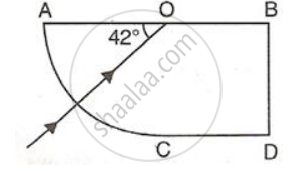
A ray of light enters a glass slab ABDC as shown in figure and strikes at the centre O of the circular part AC of the slab. The critical angle of glass is 42°. Complete the path of the ray till it emerges out from the slab. Mark the angles in the diagram wherever necessary.
Select from the following the best experimental set-up for tracing the path of a ray of light through a glass slab: (A) I
(A) I
(B) II
(C) III
(D) IV
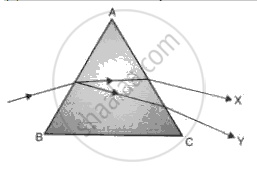
Fig. shows a ray of white light that passes through a prism and produces a spectrum.
(a) Name the phenomenon that is taking place.
(b) What colour would you see at X and Y?
(c) What radiation would you detect above X and below Y?