Advertisements
Advertisements
Question
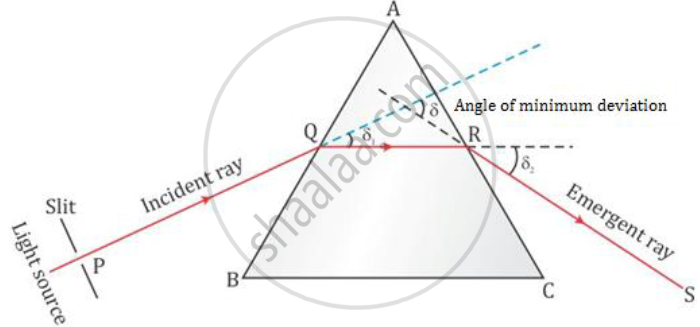
Draw a ray diagram to show the refraction of a monochromatic ray through a prism when it suffers minimum deviation.
Advertisements
Solution
Refraction of a monochromatic ray through a prism when it goes through minimum deviation:
RELATED QUESTIONS
Explain how the formation of a rainbow occurs.
Draw a ray diagram to show the refraction of light through a glass slab and mark angle of refraction and the lateral shift suffered by the ray of light while passing through the slab.
How does the angle of minimum deviation produces by a prism change with increase in :
the wavelength of incident light
A ray of light is passing from a transparent medium 1 to another transparent medium 2 (i) Speed up (ii) slows down. In each case, state whether the refractive index of medium 2 is equal to, less than or greater than the refractive index of medium 1.
A student traces the path of a ray of white light through a rectangular glass slab and marks, the angles of incidence (∠i) , refraction (∠r) and emergence (∠e) as shown. Which angle or angles has he not marked correctly?

(A) ∠i only
(B) ∠i and ∠r
(C) ∠i and ∠e
(D) ∠r and ∠e
Name the material for which the refractive index is found to be maximum.
Explain briefly what causes the twinkling of stars at night.
In what condition a prism is said to be in the position of minimum deviation? What is the direction of the refracted ray inside the prism in this condition?
In the diagram below, PQ is a ray of light incident on a rectangular glass block.

How are the angles ‘i’ and ‘e’ related to each other?
How will you verify the laws of refraction or how the refractive index of glass is determined in the laboratory?
