Advertisements
Advertisements
प्रश्न
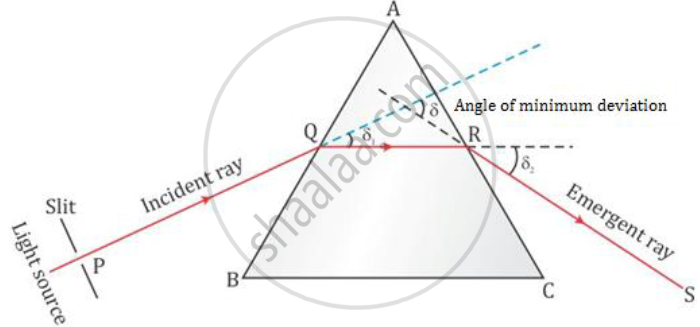
Draw a ray diagram to show the refraction of a monochromatic ray through a prism when it suffers minimum deviation.
Advertisements
उत्तर
Refraction of a monochromatic ray through a prism when it goes through minimum deviation:
संबंधित प्रश्न
Draw a ray diagram to show the refraction of light through a glass slab and mark angle of refraction and the lateral shift suffered by the ray of light while passing through the slab.
A student has traced the path of a ray of light through a glass slab as follows. If you are asked to label 1, 2, 3 and 4, the correct sequencing of labeling ∠i, ∠e, ∠r and lateral displacement respectively is
(a) 2, 1, 3, 4
(b) 1, 2, 3, 4
(c) 1, 3, 2, 4
(d) 1, 3, 4, 2
A ray of light passes from air to water. In fig. 39, which of the ray A, B, C and D is the correct refracted ray?
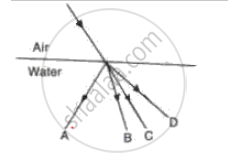
Fig shows a lens as a combination of a glass block and two prisms.
(i) Name the lens formed by the combination.
(ii) What is the line XX' called?
(iii) Complete the path of the incident ray PQ after passing through the lens.
(iv) The final emergent ray either meets XX' at a point or appears to come from a point on XX'. Label it as F, What is this point called?
In the diagram below, PQ is a ray of light incident on a rectangular glass block.

Copy the diagram and complete the path of the ray of light through the glass block. In your diagram, mark the angle of incidence by letter ‘i’ and the angle of emergence by the letter ‘e’.
Draw a diagram to show the refraction of a monochromatic light ray through an equilateral prism. On the diagram, label the incident, refracted, and emergent rays. It also indicates the angle of deviation by the letter δ.
The diagram shows the path of a ray of light through a rectangular glass block placed in a liquid of uniform density.

What is the angular, deviation of the emergent ray from the glass block with respect to the incident ray?
A coin placed at the bottom of a beaker appears to be raised by 4.0 cm. If the refractive index of water is 4/3, find the depth of the water in the beaker.
