Advertisements
Advertisements
प्रश्न
In your laboratory you trace the path of light rays through a glass slab for different values of angle of incidence (∠i) and in each case measure the values of the corresponding angle of refraction (∠r) and angle of emergence (∠e). On the basis of your observations your correct conclusion is:
(a) ∠i is more than ∠r, but nearly equal to ∠e
(b) ∠i is less then ∠r, but nearly equal to ∠e
(c) ∠i is more than ∠e, but nearly equal to ∠r
(d) ∠i is less than ∠e, but nearly equal to ∠r
Advertisements
उत्तर
(a) ∠i is less than ∠r but nearly equal to ∠e.
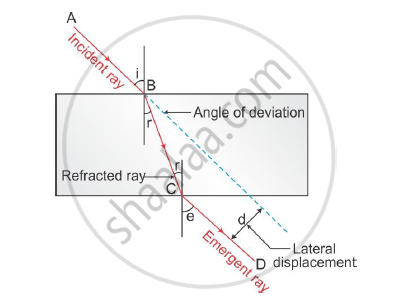
On entering a glass slab, the incident light gets refracted. According to Snell’s law, we get
`mu=sini/sinr`
For glass μ > 1
∴sinr < sini
or r < i
In refraction of light through a glass slab, the emergent ray is parallel to the incident ray. Thus, ∠i = ∠e.
